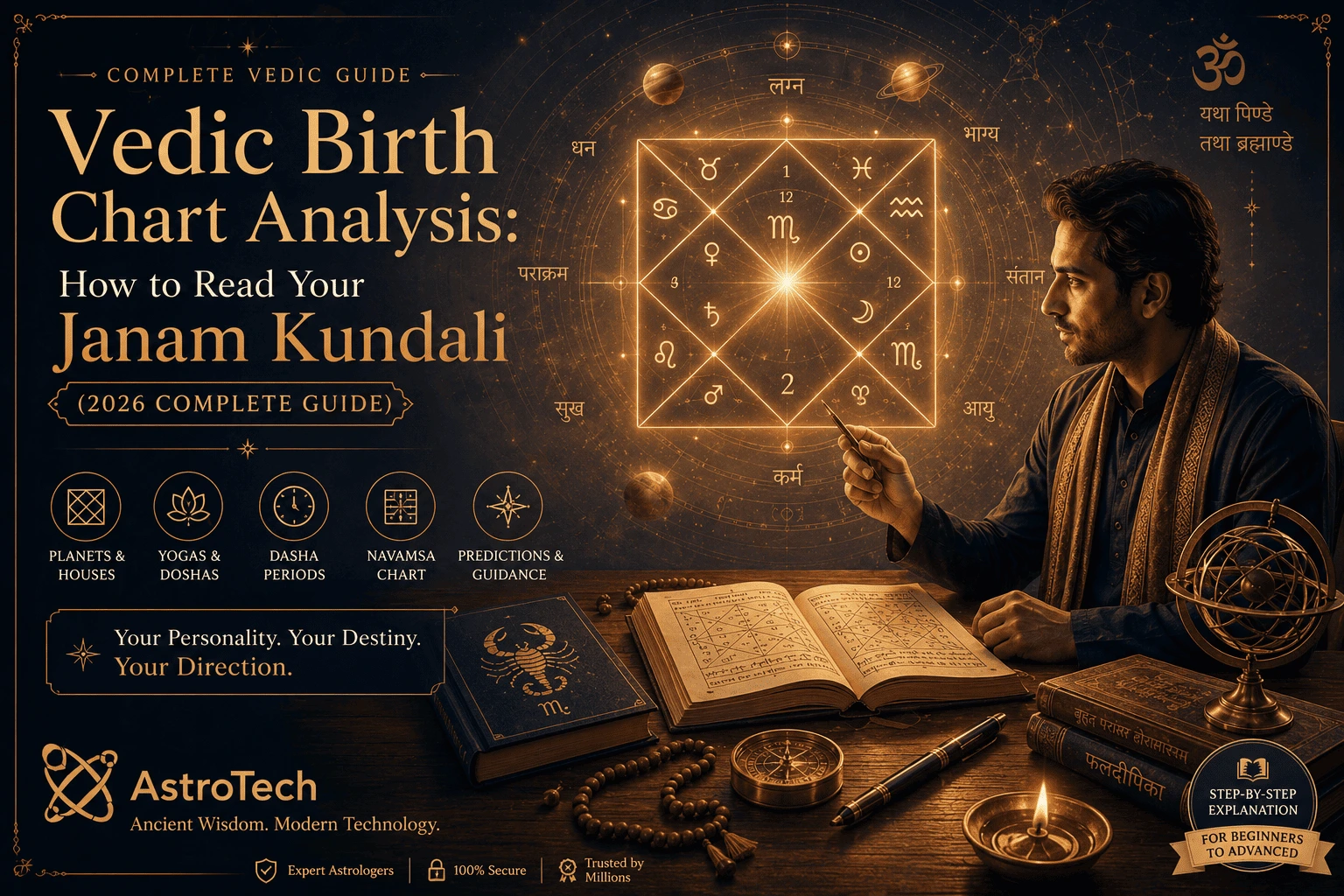

What is a Vedic Birth Chart Analysis?
A Vedic birth chart analysis (Janam Kundali) is the systematic interpretation of the exact positions of nine planets across twelve houses at the precise moment and location of your birth. It reveals your personality, career potential, marriage timing, health patterns, karmic debts, and life purpose by examining planetary dignities, Dasha periods, Yogas, and Doshas — and how they interact as a complete system.
Unlike a basic Kundli printout, a professional analysis interprets planetary interactions that an auto-generated tool cannot — making it the most personalised astrological tool available in Vedic tradition.
Key Takeaways at a Glance
- Janam Kundali maps the positions of nine planets across twelve houses at the exact moment and location of your birth.
- Your Lagna (Ascendant) changes every two hours — meaning even siblings born on the same day can have fundamentally different charts.
- The Vimshottari Dasha is a 120-year planetary timeline that converts a static birth chart into a predictive calendar for your life.
- Yogas (such as Raj Yoga and Gaj Kesari Yoga) are planetary combinations that unlock wealth, success, and wisdom when activated by the right Dasha period.
- Doshas (Mangal, Kaal Sarp, Pitra) are present in most charts; their actual impact depends on severity, planetary strength, and timing — not their mere existence.
- The Navamsa (D9) chart is essential for marriage analysis; the D1 chart shows marriage circumstances, while D9 reveals the quality and character of married life.
- Exact birth time is non-negotiable — even a 10-minute error can shift your Lagna, alter house lords, and invalidate divisional charts.
Why Your Birth Chart Is a Personalised Life Map
Think about the last major decision you faced — a career move, a relationship question, a financial crossroads. You wished someone could hand you a cheat sheet of your strengths, blind spots, and ideal timing. That is precisely what your Janam Kundali provides, in the most literal sense.
Your Vedic birth chart is not a generic horoscope. It is an astronomical record of where every planet sat at the exact second you took your first breath — unique to you, your birthplace, and your birth moment. Every house, every planetary angle, every Yoga and Dosha in that chart tells a piece of your story: your temperament, your habits, the kind of partner you are drawn to, and the career that fits your energy best.
The problem is that most people only ever see a free Kundli printout and assume that is the whole picture. It is not. A real birth chart analysis examines planetary dignity, Dasha timing, Yoga activation, Dosha severity, and divisional chart confirmations — layers that auto-generated tools skip entirely. This guide walks you through every piece of that puzzle.
Free Kundali vs Premium Birth Chart Analysis: What Is the Difference?
A free Kundli from any website shows you which planets sit in which houses and signs at birth. That is step one — and it is valuable as a starting point. But there is a significant gap between seeing a chart and understanding it.
A professional Vedic birth chart analysis examines:
- All 12 houses and their lords — identifying which are strong, weak, or under stress.
- Planetary dignities — whether each planet is exalted, debilitated, in its own sign, or combust.
- Active Dasha periods — which planet governs your life right now, and what comes next.
- Yogas — specific planetary combinations pointing to wealth, leadership, or wisdom.
- Doshas — where your chart has friction points, with targeted remedies.
- Divisional charts — especially Navamsa (D9) for marriage and Dasamsa (D10) for career.
“The Rashi chart is like a tree, but the Navamsha is the fruit. Without the D9 chart, we cannot judge the true strength of a planet, especially regarding marriage and fortune.”
| Feature | Free Kundli Tool | Premium Birth Chart Analysis |
| Lagna & planet positions | ✓ Yes | ✓ Yes |
| House-wise planet chart | ✓ Yes | ✓ Yes, with lord analysis |
| Dasha period listing | Basic dates only | Full interpretation + life event timing |
| Yoga identification | Rarely included | All major and minor Yogas explained |
| Dosha detection | Sometimes flagged | Full severity check + custom remedies |
| Divisional charts (D9, D10) | Not usually | Included and interpreted |
| Personalised life guidance | ✗ No | Career, marriage, and health focus |
| Expert astrologer review | ✗ No | ✓ Yes |
A free Kundli is the X-ray. A professional birth chart analysis is the full diagnostic report from a specialist.
Your Ascendant (Lagna): The Most Personalised Point in Your Birth Chart
If there is one element that makes your Vedic chart uniquely yours, it is the Lagna. The Ascendant is the zodiac sign rising on the eastern horizon at the exact time of your birth — and it shifts every two hours. Even a five-minute difference in birth time can completely alter your divisional charts (Vargas) and change the meaning of your entire reading.
The Lagna shapes your physical appearance, demeanour, and default reactions to life’s challenges. Crucially, it tells an astrologer which planets carry the most influence over you — and which transits are beneficial or malefic for your specific chart.
| ⚠️ | Birth time accuracy is non-negotiable.Even a 10-minute error can shift your Lagna, change house lordships, and render your divisional charts inaccurate.Always verify against your birth certificate or hospital records. If birth time is unavailable, ask your astrologer about birth time rectification. |
Quick Reference: The 12 Lagna Signs and Their Core Traits
| Lagna Sign | Sanskrit Name | Core Personality Traits |
| Aries | Mesha | Bold, action-oriented, competitive, pioneering |
| Taurus | Vrishabha | Stable, pleasure-seeking, patient, materially focused |
| Gemini | Mithuna | Curious, communicative, restless, intellectually versatile |
| Cancer | Karka | Nurturing, emotional, intuitive, home-centred |
| Leo | Simha | Confident, dramatic, generous, authority-seeking |
| Virgo | Kanya | Analytical, practical, detail-focused, service-oriented |
| Libra | Tula | Diplomatic, beauty-loving, partnership-oriented, indecisive |
| Scorpio | Vrishchika | Intense, secretive, transformative, psychologically perceptive |
| Sagittarius | Dhanu | Philosophical, adventurous, blunt, truth-seeking |
| Capricorn | Makara | Disciplined, ambitious, structured, long-term focused |
| Aquarius | Kumbha | Unconventional, humanitarian, detached, innovation-driven |
| Pisces | Meena | Intuitive, spiritual, compassionate, boundary-dissolving |
The 12 Houses of a Kundali: What Each House Governs
A Janam Kundali is divided into twelve houses, each governing a distinct life domain. The positions of planets within these houses determine how — and how strongly — they influence each area of your life.
| House | Sanskrit Name | Life Domain | Key Themes |
| 1st | Tanu Bhava | Self, Body | Personality, appearance, overall health, first impressions |
| 2nd | Dhana Bhava | Wealth, Speech | Finances, family, accumulated assets, voice |
| 3rd | Sahaja Bhava | Courage, Siblings | Courage, short journeys, media, communication skills |
| 4th | Sukha Bhava | Home, Mother | Domestic life, property, emotional roots, vehicles |
| 5th | Putra Bhava | Children, Creativity | Intelligence, romance, speculation, past life merit |
| 6th | Shatru Bhava | Enemies, Health | Debts, disease, daily work, legal disputes |
| 7th | Kalatra Bhava | Marriage, Partnerships | Spouse qualities, business partnerships, open adversaries |
| 8th | Mrityu Bhava | Longevity, Secrets | Transformation, inheritance, sudden events, occult |
| 9th | Dharma Bhava | Luck, Philosophy | Fate, father, higher education, long journeys, religion |
| 10th | Karma Bhava | Career, Status | Profession, public reputation, authority, achievements |
| 11th | Labha Bhava | Gains, Income | Profits, elder siblings, social networks, aspirations |
| 12th | Vyaya Bhava | Losses, Liberation | Foreign lands, isolation, spiritual moksha, expenses |
The Big Three: Sun, Moon, and Ascendant Lord
In Vedic astrology, three placements form the foundation of any reading:
- Sun (Surya): Your soul’s purpose, authority, and core identity. Weak Sun often manifests as self-confidence issues or difficult relationships with authority figures.
- Moon (Chandra): Your emotional life, mental patterns, and subconscious. The Moon’s Nakshatra determines your starting Mahadasha — making it one of the most prediction-critical placements in the chart.
- Ascendant Lord (Lagna Lord): The planet ruling your rising sign is the captain of your entire chart. A strong, well-placed Lagna Lord gives resilience and agency. A combust, debilitated, or 6th/8th/12th-house Lagna Lord often correlates with a more turbulent life path.
Saturn and Jupiter: The Karmic Heavyweights
Jupiter (Guru) and Saturn (Shani) define your long-term trajectory in Vedic astrology:
- Jupiter brings expansion, wisdom, opportunity, and blessings. It is the primary significator of wealth in combination with the 2nd and 11th houses.
- Saturn brings discipline, delays, karmic lessons, and ultimately — lasting achievement. Saturn in the 10th house, for example, often correlates with a slow but exceptionally durable career peak.
Rahu and Ketu: Karmic Magnifiers, Not Simple Malefics
Rahu (North Node) and Ketu (South Node) are shadow points — not physical planets — but their influence in a chart is profound. Rahu amplifies obsessive desire and worldly ambition in whatever house it occupies. Ketu promotes detachment, spiritual insight, and the release of past-life patterns.
Their effects are nuanced: a malefic outcome is never automatic. House placement, sign dignity, Nakshatra rulership, and the Dasha timing all determine whether Rahu or Ketu function constructively or disruptively.
Major Yogas in Your Birth Chart: Wealth, Fame, and Success Indicators
Yogas are specific planetary patterns that, when activated by the correct Dasha period, can redirect the entire course of a life. Nearly every chart contains some Yogas — but their potency depends on the dignity of the planets involved, the absence of disrupting malefics, and critically, whether the active Dasha belongs to a planet involved in the Yoga.
The Four Most Significant Yogas to Check
1. Raj Yoga — Power, Authority, and Status
Raj Yoga forms when the lord of a Kendra house (1st, 4th, 7th, or 10th) combines with the lord of a Trikona house (1st, 5th, or 9th) through conjunction, mutual aspect, or sign exchange. It signals leadership, social elevation, and institutional power. Almost every chart carries a version of Raj Yoga — its strength hinges on the planetary dignity of the lords involved.
2. Gaj Kesari Yoga — Wisdom, Respect, and Steady Wealth
Formed when Jupiter occupies a Kendra house (1st, 4th, 7th, or 10th) from the natal Moon. It produces wisdom, public respect, and material stability. Because Gaj Kesari Yoga is relatively common, always verify the strength of Jupiter (is it exalted, retrograde, combust?) before interpreting its effects.
3. Dhana Yoga — Financial Abundance
Involves connections between the lords of the 2nd, 5th, 9th, and 11th houses — the wealth-building axis of the chart. A strong Dhana Yoga with well-placed lords and an active supporting Dasha period is one of the clearest indicators of material prosperity.
4. Neech Bhang Raj Yoga — Debilitation Transformed
A rare and powerful Yoga occurring when a debilitated planet receives cancellation through specific astrological conditions — for example, when the lord of the sign where debilitation occurs is powerful and well-placed. The debilitated planet then produces results that can exceed what a normally dignified planet achieves. This is one of the most misunderstood Yogas in Vedic astrology.
How to Identify Yogas in Your Birth Chart: A Step-by-Step Process
This is a HowTo-structured checklist for featured snippet and AI answer optimisation:
- Identify the lords of your Kendra houses (1, 4, 7, 10) and Trikona houses (1, 5, 9).
- Check whether any two lords share a house, aspect each other mutually, or exchange signs (Parivartana).
- Verify planetary strength: is each lord exalted, in its own sign, or retrograde? Is it combust or hemmed by malefics?
- Check for disruptors: are Rahu, Ketu, or a combust planet breaking the Yoga combination?
- Confirm the Dasha period: identify whether the Mahadasha or Antardasha of any involved planet is currently active or upcoming.
| 💡 | Critical insight: A textbook Raj Yoga in your chart can remain dormant for decades if the Dasha of its involved planets has not yet started — or has already passed.Timing is not secondary to Yoga analysis. Timing IS the analysis. |
Doshas in Your Birth Chart: Mangal, Kaal Sarp, Pitra, and Shrapit Doshas
The word ‘Dosha’ literally means flaw or imbalance — and hearing you have one can create unnecessary panic. Here is the reality: most birth charts carry at least one form of Dosha. Their impact is not fixed; it depends on severity, active Dasha timing, and the strength of counterbalancing benefic planets.
Mangal Dosha (Manglik Dosha)
Mangal Dosha forms when Mars occupies the 1st, 2nd, 4th, 7th, 8th, or 12th house from the Lagna or Moon. Since Mars governs conflict, intensity, and desire, its placement in these houses can create friction in the life domains each house represents — most notably marriage and domestic harmony.
However, the Dosha’s intensity drops sharply when Mars is in its own sign (Aries or Scorpio), when both partners are Manglik, or when Jupiter’s beneficial aspect is present. A blanket ‘Manglik = bad marriage’ reading is an oversimplification.
Common remedies: Kumbh Vivah (ceremonial marriage to a clay pot), Mangal Shanti Puja, daily recitation of Hanuman Chalisa, or pairing with a Manglik partner.
Kaal Sarp Dosha
This Dosha forms when all seven classical planets (Sun through Saturn) are hemmed between the Rahu-Ketu axis. It can correlate with mental unrest, cyclical obstacles, and a persistent sense of being blocked. Partial Kaal Sarp — where one or more planets fall outside the axis — is considerably milder than full Kaal Sarp.
Common remedies: Kaal Sarp Dosha Nivaran Puja, Rahu-Ketu mantra recitation, Nag Panchami rituals.
Pitra Dosha
Often linked to ancestral karmic debt. Typically indicated when the Sun is afflicted by Rahu, Ketu, or Saturn — suggesting unresolved obligations from previous generations. It can manifest as recurring family conflicts, financial blocks, or hereditary health patterns.
Common remedies: Pitru Dosha Nivaran Puja, Shradh rituals on Pitru Paksha, donating sesame seeds, feeding Brahmins.
Shrapit Dosha
Formed by a conjunction of Saturn and Rahu, typically indicating heavy karmic debt accumulated over lifetimes. It can delay major life milestones and create persistent, seemingly inexplicable obstacles in career, health, or relationships.
| ✓ | Reality check on Doshas: They are speed bumps, not brick walls.A skilled astrologer examines the whole chart — benefic strengths, active Dashas, and counterbalancing Yogas — before assessing Dosha impact.Remedies work best when they are targeted to your specific chart, not generic prescriptions. |
The Dasha System: Timing Your Life Events Through Planetary Periods
If Yogas and Doshas tell you what is possible in your chart, the Dasha system tells you when. This timing mechanism is one of Vedic astrology’s most powerful features — one that has no direct equivalent in Western astrology.
The Vimshottari Dasha system divides life into planetary periods spanning a total of 120 years. The sequence of periods is fixed; what changes is which planet you begin with — determined by the Moon’s Nakshatra at the moment of your birth.
Vimshottari Dasha: Duration of Each Planetary Period
| Planet | Mahadasha Duration | Key Life Themes During This Period |
| Ketu | 7 years | Spirituality, past karma, detachment, health fluctuations |
| Venus (Shukra) | 20 years | Relationships, wealth, creativity, comfort, partnerships |
| Sun (Surya) | 6 years | Authority, career, ego, father, government |
| Moon (Chandra) | 10 years | Emotions, mother, mind, home, public life |
| Mars (Mangal) | 7 years | Energy, ambition, property, siblings, conflict |
| Rahu | 18 years | Ambition, foreign elements, innovation, materialism |
| Jupiter (Guru) | 16 years | Wisdom, expansion, children, religion, fortune |
| Saturn (Shani) | 19 years | Discipline, delays, karmic lessons, service, longevity |
| Mercury (Budha) | 17 years | Communication, intellect, business, education |
How to Read Your Current Mahadasha and Antardasha
- Identify your Moon’s Nakshatra (constellation) at the time of birth.
- The planetary ruler of that Nakshatra is your first Mahadasha lord.
- Calculate how much of that first Mahadasha remained at your birth date.
- Follow the fixed sequence: Ketu → Venus → Sun → Moon → Mars → Rahu → Jupiter → Saturn → Mercury.
- Within each Mahadasha, Antardasha sub-periods follow the same sequence starting from the Mahadasha lord.
In practice: if you are running Jupiter Mahadasha and Jupiter is your 9th lord sitting exalted in Cancer, expect a golden period of growth, travel, and good fortune. But if Jupiter is debilitated and afflicted, the same Mahadasha period may bring confusion or misplaced optimism. The planet’s dignity in your natal chart determines whether its Dasha works for you or against you.
Marriage Compatibility and the Navamsa (D9) Chart
Marriage is consistently the most searched topic in Vedic astrology. And here is what surprises most people: the main birth chart (D1) alone is insufficient to judge your married life. The Navamsa chart — known as the D9 chart — is indispensable.
Each zodiac sign is divided into nine equal Navamsa segments. The Navamsa chart derived from these divisions is so fundamental that many classical astrologers consider it the second-most important chart after the Rashi (D1) chart itself.
D1 vs D9: What Each Chart Reveals
| Chart | What It Shows | Marriage-Specific Insights |
| D1 (Rashi Chart) | Life circumstances, events, external situations | Whether and when marriage may occur; external factors affecting partnership |
| D9 (Navamsa Chart) | Inner character, relationship quality, destiny | Spouse nature, emotional compatibility, quality of married life, post-marriage evolution |
| Combined Analysis | Complete picture | Marriage timing (when), circumstances (how), quality (what the relationship feels like inside) |
Key Insights the Navamsa Chart Reveals About Marriage
- Spouse nature: The 7th house lord of D9, Venus (for men), and Jupiter (for women) describe the qualities of your spouse in detail.
- Marriage timing: Navamsa helps refine timing when Dasha periods connect with the Navamsa 7th house, Venus, or Jupiter.
- Quality of marital life: While D1 indicates the possibility of marriage, D9 reveals how that marriage actually functions — stability, adjustment, mutual respect, and long-term outcome.
- Post-marriage transformation: The Navamsa is strongly associated with the second half of life, particularly after age 40, making it crucial for understanding personal evolution through partnership.
Kundali Matching: Beyond the Ashtakoota Score
Traditional compatibility matching in Vedic astrology uses two primary methods:
- Ashtakoota (Gun Milan): Used primarily in North India, this scores eight compatibility factors from Nakshatra data, producing a score out of 36 points.
- Dashakoota (Porutham): Used primarily in South India, this evaluates ten compatibility factors.
However, a high Ashtakoota score alone does not guarantee a successful marriage — and a lower score does not predict failure. A premium compatibility analysis examines both partners’ D9 charts, cross-references 7th house lords, assesses Venus and Jupiter’s strength in both charts, and identifies whether the Dasha timing supports a harmonious union.
Career Prediction in Your Birth Chart: The 10th House and Beyond
Your 10th house — Karma Bhava — is the primary indicator of career, profession, and public status in Vedic astrology. But an accurate career reading draws on multiple chart elements working together.
What an Astrologer Examines for Career Prediction
- 10th house and its lord: The sign ruling the 10th house and where its lord is placed identifies the direction and quality of your professional life.
- Saturn’s role: Saturn governs discipline, structured labour, and long-term achievement. Its aspect on the 10th house often shapes the nature of sustained career effort required.
- Jupiter’s influence: Jupiter’s connection to the 10th or 11th house frequently signals advisory, educational, legal, or financial careers.
- Dasha timing: Career peaks most commonly coincide with the Mahadasha or Antardasha of the 10th house lord or a planet strongly aspecting the 10th.
- Dasamsa (D10) chart: The divisional chart specifically designed for career analysis — confirming and deepening what the D1 shows.
Example: If your 10th lord is Mercury placed in the 2nd house, you may excel in communication-heavy careers — writing, media, marketing, or finance. If Mars rules your 10th and sits in the 1st house, leadership roles and technical or engineering fields are often a strong natural fit.
Baby Naming from the Birth Chart: Nakshatra-Based Name Selection
One of the most practical uses of Janam Kundali for new parents is identifying the astrologically ideal starting syllable for a baby’s name — determined by the Moon’s Nakshatra (birth constellation) at the time of birth.
There are 27 Nakshatras, each assigned specific syllables. A name beginning with the correct syllable is believed to align the child’s identity with the positive energy of their birth Nakshatra, supporting good health, success, and temperament.
| Nakshatra | Pada 1 | Pada 2 | Pada 3 | Pada 4 |
| Ashwini | Chu | Che | Cho | La |
| Bharani | Li | Lu | Le | Lo |
| Krittika | A | Ee | U | Ea |
| Rohini | O | Va | Vi | Vu |
| Mrigashira | Ve | Vo | Ka | Ki |
| Punarvasu | Ke | Ko | Ha | Hi |
| Pushya | Hu | He | Ho | Da |
6 Common Mistakes People Make With Birth Chart Analysis
- Using an approximate birth time. Even a 10-minute error can shift your Lagna and alter every house lord assignment. Always use the time recorded on your birth certificate.
- Relying only on Moon sign horoscopes. Newspaper and app horoscopes are generalisations for millions of people sharing the same Moon or Sun sign. Your Kundali is specific to you.
- Panicking over a Dosha. Doshas are part of most charts. Real impact depends on severity, planetary strengths, and active Dashas — not mere presence.
- Ignoring divisional charts. The D1 chart is just the starting point. D9 for marriage, D10 for career, D7 for children — these layers add essential depth.
- Skipping Dasha analysis. A Yoga or Dosha has minimal predictive value without knowing when it activates. Timing is the backbone of Vedic prediction.
- Confusing Vedic and Western systems. Western astrology uses the Tropical (Sayana) system; Vedic uses the Sidereal (Nirayana) system. This creates a roughly 23-degree difference in planetary positions between the two charts — they are not interchangeable.
Myth vs Reality: 8 Birth Chart Misconceptions Corrected
| Common Myth | Evidence-Based Reality |
| Vedic astrology is mere superstition | It is a mathematical system derived from astronomical positions, codified in classical texts like the Brihat Parashara Hora Shastra — one of the oldest systematic astrological frameworks in human history. |
| Mangal Dosha means I will never marry | Most charts carry some form of Mangal Dosha; its severity varies widely, and numerous effective remedies are documented in classical texts. |
| Free Kundli gives me everything I need | It provides planet positions but omits interpretation, Yoga analysis, Dosha severity assessment, and Dasha predictions — the analytical layers that make a chart meaningful. |
| Birth chart predictions are fixed and unchangeable | Vedic astrology explicitly acknowledges free will alongside planetary influence; remedies are recommended precisely because outcomes can shift. |
| Only Sun sign matters | In Vedic tradition, Moon sign and Lagna carry more predictive weight than Sun sign — the Sun’s sign matters, but is rarely the primary reference point. |
| Rahu and Ketu are always harmful | They are karmic catalysts; their effects depend entirely on house placement, sign dignity, and Nakshatra rulership — not their inherent nature. |
| Astrology predicts exact event dates | Vedic astrology identifies windows of probability through Dasha-transit overlaps — not pinpoint calendar dates. |
| All astrologers read charts identically | Regional traditions, chart styles (North vs South Indian format), classical text lineages, and individual expertise create meaningful differences in interpretation. |
Frequently Asked Questions: Vedic Birth Chart Analysis
These questions are structured to match Google’s ‘People Also Ask’ patterns and AI Overview extraction logic.
1. How accurate is Vedic birth chart analysis?
Accuracy depends on two factors: the precision of your birth time and the expertise of the astrologer. With exact birth data and professional interpretation, Vedic astrology has a strong documented track record for identifying life patterns, strengths, and the timing of major events. Birth time errors remain the primary source of inaccurate readings.
2. Do I need my exact birth time to generate a Kundli?
Yes — and this is non-negotiable. The Ascendant (Lagna) shifts every two hours, meaning even small time errors change your Lagna, alter house lordships, and invalidate divisional charts like the D9. If your exact time is unknown, look for birth certificates or hospital records. As a last resort, ask your astrologer about birth time rectification using significant life events.
3. What is the difference between a horoscope and a Janam Kundali?
A horoscope (daily, weekly, or monthly) is a generalised prediction based on Moon sign or Sun sign — applicable to millions of people simultaneously. A Janam Kundali is your personal birth chart, calculated from your specific date, time, and place of birth, making it unique to you alone.
4. Can Vedic astrology predict marriage timing?
Yes, with reasonable accuracy within a probability window. Vedic astrologers cross-reference the 7th house lord’s active Dasha, Jupiter and Venus transits, and the Navamsa chart to identify likely marriage periods. This produces a timing window — typically a period of one to three years — rather than an exact date.
5. How does birth chart analysis help with career decisions?
The 10th house, its lord’s placement, and Saturn and Jupiter’s positions identify career fields aligned with your natural strengths. Dasha analysis then reveals when career moves are likely to succeed — helping you time promotions, business launches, or field changes for maximum effectiveness.
6. What health insights can a birth chart provide?
The 2nd, 6th, 8th, and 12th houses, along with afflictions to the Sun and Moon, flag potential health vulnerabilities. The 6th house covers acute illness and chronic conditions; the 8th governs surgeries and sudden health events; the 12th relates to hospitalisation and recovery. These are indicators for awareness — not medical diagnoses.
7. Is Kundali matching necessary before marriage?
In Vedic tradition, it is strongly recommended. Basic Ashtakoota (Gun Milan) matching produces a compatibility score, but a D9-based analysis assesses emotional compatibility, adjustment capacity, and long-term relational harmony at a much deeper level. A score alone without D9 analysis leaves the most important questions unanswered.
8. What if I have multiple Doshas in my chart?
This is far more common than most people realise. Many individuals carry Mangal Dosha alongside partial Kaal Sarp, for example. What matters is the overall strength of benefic planets in the chart, the active Dasha period, and whether other Yogas provide counterbalancing positive influence. Multiple Doshas do not compound into catastrophe — they require nuanced interpretation.
9. What is the difference between Vedic and Western astrology?
Vedic (Jyotish) astrology uses the Sidereal zodiac, which is aligned with the actual constellations in the sky. Western astrology uses the Tropical zodiac, which is fixed to the seasons. This creates approximately a 23-degree difference in planetary positions between the two systems. They originate from different philosophical traditions and use different predictive methods — a chart from one system cannot simply be translated to the other.
10. Can astrology change my fate or destiny?
Vedic astrology does not claim to override destiny. It offers awareness and a set of remedial measures — mantras, gemstones, donations, rituals — that practitioners believe help reduce negative planetary influences and amplify positive ones. The metaphor that resonates most: it is driving with GPS versus driving blind. The road is the same; but informed choices lead to better outcomes.
What You Gain from a Professional Birth Chart Analysis
| Life Area | What the Analysis Reveals | Practical Benefit |
| Career | Fields aligned with chart strengths; Dasha periods favouring career moves | Confident career decisions with timing guidance |
| Relationships | Compatibility patterns, marriage timing, ideal partner qualities | Better partner selection and relationship awareness |
| Finances | Dhana Yogas, 2nd/11th house strength, peak earning periods | Financial planning aligned with favourable periods |
| Health | 6th/8th house afflictions, vulnerable life periods | Proactive health awareness and preventive focus |
| Life decisions | Dasha-transit overlaps for key events (property, business, relocation) | Timing major decisions to align with supportive periods |
| Peace of mind | Clarity on chart strengths, Dosha reality checks, and what your chart actually says | Reduction of astrology-based fear and anxiety |
Conclusion
Your birth chart is the most personalised document you will never lose. It was written the moment you were born, and it remains constant through every career shift, relationship, and turning point in your life. The challenge is that it is written in a language most people never learn to read.
This guide has covered the foundational layers: the Lagna that personalises your entire chart, the 12 houses and their life domains, the planetary interactions that form Yogas and Doshas, the Dasha system that turns a static chart into a predictive timeline, and the Navamsa chart that unlocks the deeper story of marriage and personal evolution.
Reading about your birth chart is not the same as getting yours properly read. The patterns in your specific chart require a trained eye — someone who can cross-reference your houses, planets, Yogas, Doshas, and Dasha periods and translate all of it into real, actionable guidance.
Start with a free Kundali to see your chart and understand the layout. When you are ready for the complete picture — your Yogas, your Dosha severity, your next chapter’s timing — a Premium Birth Chart Analysis is built to deliver exactly that.
Your stars have something to say. The question is whether you are ready to listen with clarity.
Leave a Reply