Author: Samarendra Bisoyi

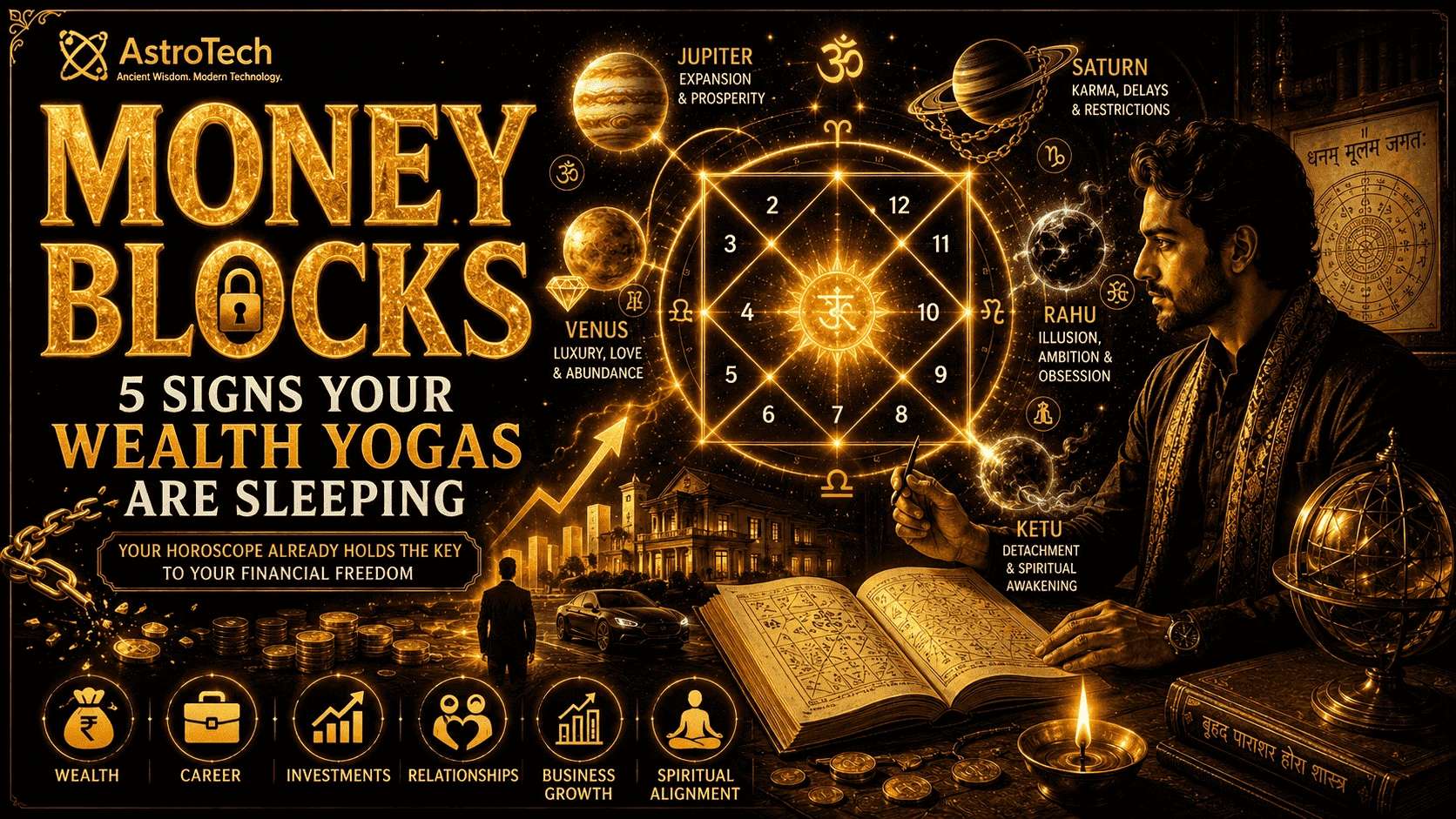
  • Money Blocks in Your Horoscope: 5 Signs You’re Underusing Your Wealth Yogas

    Money Blocks in Your Horoscope: 5 Signs You’re Underusing Your Wealth Yogas

    You work hard. You have good ideas. You may even earn well.

    But money feels inconsistent, stuck, or just never quite enough.

    In Vedic astrology, this is rarely about bad luck. It is almost always about wealth yogas that exist in your chart but are not being activated.

    Most people with powerful Dhana Yogas still struggle financially — not because the planets are against them, but because of inactive planetary periods, career misalignment, weak financial habits, or blocked house energies they never knew to look for.

    Your horoscope may already contain the blueprint for abundance. The question is whether you are reading it — and using it.

    This guide explains:

    • What wealth yogas actually are in Vedic astrology
    • The most powerful combinations to look for
    • 5 clear signs your wealth yogas are underused
    • How to activate them with practical, modern steps
    • Answers to the most common questions about money and horoscopes

    What Are Wealth Yogas in Astrology?

    Wealth yogas — also called Dhana Yogas — are specific planetary combinations in a Vedic birth chart associated with financial growth, income opportunities, asset accumulation, and material abundance.

    In simple terms: they are the astrological conditions that indicate a person’s capacity to earn, attract, retain, and grow wealth.

    The most important wealth indicators in a horoscope are:

    • 2nd house — accumulated wealth, savings, family resources
    • 11th house — income, gains, financial networks
    • Jupiter — expansion, financial wisdom, fortune
    • Venus — luxury, material enjoyment, cash flow
    • Mercury — business, contracts, income through skills
    • Connection between 2nd and 11th lords — the core Dhana Yoga formula

    The most recognised wealth combinations include:

    YogaWhat It Means
    Dhana Yoga2nd and 11th lords connect through conjunction, exchange, or aspect
    Lakshmi YogaVenus and Jupiter both placed in Kendra or Trine houses
    Bhadra YogaMercury in its own sign in the 6th, 7th, or 8th house — wealth through intelligence
    Guru-Mangal YogaJupiter and Mars combination — wealth through bold, disciplined action

    Critical point: Having a wealth yoga does not automatically mean financial success. A yoga must be activated — through the right planetary period (Mahadasha), aligned career choices, and conscious financial behaviour. An un-activated wealth yoga is like a cheque that was never cashed.

    Why People With Strong Wealth Yogas Still Struggle

    This is the question most astrology content refuses to answer directly.

    The honest answer: timing, alignment, and awareness.

    Even with a textbook Dhana Yoga, financial growth can stall because:

    • You are not in the Mahadasha or Antardasha of the planet that owns the yoga
    • Your career is misaligned with the houses that support your wealth potential
    • Saturn is creating delays through its transit or period
    • Rahu is creating illusion — you feel ambitious but act impulsively
    • You have the wealth potential but not the financial discipline to receive and hold it
    • Fear-based money patterns are acting as a psychological override

    Understanding which of these is active for you changes everything.

    5 Signs You Are Underusing Your Wealth Yogas

    Sign 1: You Earn Well But Never Retain Money

    You bring in income consistently. But savings never build. Every time there is surplus, something drains it — an unexpected expense, a lifestyle upgrade, a financial decision that looked smart and wasn’t.

    What the chart usually shows:

    • An afflicted or weak 2nd house (the house of accumulated wealth)
    • Rahu influencing the 2nd or 11th house — creating desire-driven spending
    • Venus debilitated or in a difficult placement — comfort spending to fill emotional gaps
    • Weak Saturn — the discipline to hold wealth is absent

    Modern money block: Lifestyle inflation. Impulse purchases. The psychology of spending money as soon as it arrives because unconsciously it does not feel safe to keep it.

    What to check: Is your 2nd house lord well-placed and unafflicted? Is Venus connected to wealth houses or placed in a way that supports retention?

    Activation step: Create a savings account you cannot touch for 90 days. Start with any amount. The act of holding money trains both the habit and the planetary energy. Venus responds to consistency in beauty and value — include something you genuinely enjoy saving toward.

    Sign 2: You Fear Investing or Scaling

    Opportunities appear. You know logically that the next step is to invest — in a business, in training, in scaling your income. But something stops you. You find reasons to wait. You move the money to a savings account with near-zero returns and call it being responsible.

    What the chart usually shows:

    • Saturn restricting the 11th house (the house of gains and financial networks)
    • Ketu in or aspecting the 2nd house — detachment from material accumulation as a subconscious pattern
    • Moon afflicted in the 4th or 8th — emotional insecurity around financial risk
    • Weak Mars — insufficient courage to act decisively

    Modern money block: The “I’ll lose it all” fear. Hoarding cash rather than putting it to work. Watching others scale their wealth while staying frozen.

    What to check: Is Saturn connected to your 11th house lord or placed in the 11th? Does Ketu sit close to wealth indicators in your chart?

    Activation step: Start with one small, recurring financial commitment — a monthly investment of any size, initiated consistently. Saturn responds to structure and repetition over time, not big gestures. Small, committed action, sustained over months, is the language this energy understands.

    Sign 3: You Earn Well But Feel It Is Never Enough

    The income is real. The number in your account is objectively fine. But the feeling of financial security never arrives. You upgrade your life, then feel the same scarcity at the new level. You compare your net worth to others constantly and always find yourself lacking.

    What the chart usually shows:

    • Rahu in the 2nd house — inflating desire so that satisfaction is always just out of reach
    • Moon in the 12th house — emotional security leaks away, making it difficult to feel financially safe regardless of what you have
    • Jupiter weak or afflicted — poor financial judgement, inability to recognise what is genuinely enough
    • Venus and Rahu together — chronic desire for more luxury and status as emotional substitute

    Modern money block: Social media comparison. The illusion that a higher income number will fix the inner feeling of inadequacy. Spending on status rather than value.

    What to check: Where is Rahu in your chart relative to wealth houses? Is your Moon placed in a way that supports emotional security or drains it?

    Activation step: Track your net worth, not your income. Shift from measuring how much flows in to measuring how much accumulates. Add a nightly practice of noting three specific things money has already provided in your life. This is not generic gratitude — it is a direct counter to Rahu’s pattern of always wanting what is not yet there.

    Sign 4: You Reject Opportunities That Feel ‘Too Commercial’

    You undercharge. You avoid sales conversations. You turn down commissions or partnerships because they feel uncomfortable, aggressive, or “not in alignment.” You want the wealth but resist the mechanics of receiving it.

    What the chart usually shows:

    • Ketu conjunct or aspecting Jupiter — a subconscious belief that money and spirituality are in conflict
    • 2nd house lord in the 12th — wealth energy directed toward giving away rather than retaining
    • Moon-Ketu connection — emotional detachment from material goals
    • Weak Mercury in wealth-related houses — difficulty negotiating, pricing, and communicating value

    Modern money block: Underpricing your work. Feeling guilty about charging what you are worth. Framing financial ambition as something spiritually or morally inferior.

    What to check: Is Ketu closely connected to Jupiter or your 2nd house lord? Does your chart show a pattern of wealth generating and then dispersing before it consolidates?

    Activation step: Reframe the belief at the root — money is not the opposite of meaning or service, it is a multiplier of it. For 40 days, use one conscious affirmation: “I receive wealth so I can give more.” Then raise one price, close one deal, or ask for one raise. The action matters as much as the internal shift.

    Sign 5: You Experience Sudden Gains Followed by Sudden Losses

    Income surges arrive — a windfall, a successful project, an unexpected opportunity. Then, equally unexpectedly, it disappears. A bad investment, a partnership collapse, an expense that wipes the gain. The cycle repeats and leaves you financially exhausted.

    What the chart usually shows:

    • Afflicted 8th house — the house of sudden gains and sudden losses, inheritances, and hidden financial events
    • Weak or debilitated Mars — poor risk assessment, impulsive financial decisions
    • Rahu and Mars together in or aspecting wealth houses — volatile, speculative financial behaviour
    • No stabilising Saturn influence on financial houses — nothing anchoring the gains

    Modern money block: High-risk financial decisions made on excitement rather than analysis. Crypto gambles, unstable business partnerships, get-rich-quick cycles that always reset to zero.

    What to check: What is the condition of your 8th house lord? Is Mars well-placed and strong in your chart? Is there any Saturn stabilisation on your financial houses?

    Activation step: Introduce a mandatory cooling period of 48 hours before any high-risk financial decision. No exceptions. Mars energy is impulsive by nature — the discipline that counters it is not avoidance but structured delay. If the opportunity is real, it will still be there two days later.

    Wealth Yoga vs. Money Block: Quick Reference Table

    Wealth Yoga PresentIf Blocked, SignPrimary CauseOne Activation Step
    Jupiter + Venus combinationSign 1: You earn but don’t retainWeak 2nd house, Venus afflicted90-day untouchable savings account
    Saturn + 11th lord strongSign 2: Fear of investingSaturn restricting gainsRecurring small investment, started this week
    Rahu in wealth housesSign 3: Never feels enoughRahu inflating desireTrack net worth, nightly wealth inventory
    Ketu + Jupiter connectionSign 4: Rejects opportunitiesMoney-spirituality conflict belief40-day affirmation + one immediate income action
    Mars + 8th house activeSign 5: Gains then lossesImpulsive risk decisions48-hour cooling rule on all high-risk moves

    How to Activate Your Dormant Wealth Yogas

    Knowing your wealth yoga exists is not enough. Activation requires four things working together.

    Step 1: Identify your Dhana Yoga. Use a reliable Vedic birth chart calculator to pull your full chart. Look at your 2nd and 11th house lords, their placement, and whether they connect — by conjunction, exchange, or mutual aspect. Note where Jupiter and Venus sit.

    Step 2: Match your money block to the 5 signs above. Be honest. Most people have one or two dominant patterns. Name them specifically.

    Step 3: Check your current Mahadasha and Antardasha. Wealth yogas activate most powerfully during the planetary period of the planet that owns the yoga. If you are in Saturn’s period and your wealth yoga is Jupiter-led, the energy is available but the timing requires patience and structural groundwork rather than fast results.

    Step 4: Apply one specific remedy for 40 days. Not all of them at once. One, consistently. Remedies work through repetition and sincere intent — the 40-day commitment builds the habit and the planetary relationship simultaneously.

    Step 5: Align your career and financial choices with your chart’s strengths. A strong Mercury in the 10th house rewards communication-based income. A powerful Venus in the 7th may indicate wealth through partnership or creative work. A well-placed Saturn in the 10th builds wealth through long-term, structural careers. Fighting your chart’s natural direction is the most common — and least discussed — money block of all.

    Planet-wise Remedies for Wealth Activation

    PlanetRemedyModern Application
    JupiterDonate to education or feed the genuinely hungryGive before you receive — not as transaction, but as principle
    VenusWear light colours on Fridays, use silverInvest in something of lasting beauty, not temporary status
    SaturnStart one discipline and hold it for 90 daysYour 401k, your daily savings, your morning routine
    MercuryRead daily, write one clear paragraph before workSharpen your ability to communicate and negotiate value
    MarsPhysical training before stressful financial decisionsChannel aggression into action, not reaction
    RahuDigital sunset, one screen-free meal dailyGround ambition in reality, not comparison
    MoonNo screens before bed, water from a silver vesselBuild emotional safety so financial security can land

    Frequently Asked Questions

    What are wealth yogas in astrology? 
    Wealth yogas, or Dhana Yogas, are planetary combinations in a Vedic birth chart that indicate strong potential for financial growth, income, and abundance. The most common involve the 2nd and 11th house lords connecting, Jupiter or Venus in key positions, or specific exchanges between wealth-related houses. They do not guarantee wealth automatically — they must be activated through timing, aligned choices, and consistent action.

    Which house is most important for wealth in Vedic astrology? 
    The 2nd house governs accumulated wealth, savings, and family resources. The 11th house governs income, gains, and financial networks. Both houses working together — with strong lords and no serious afflictions — form the foundation of a powerful wealth combination.

    Can you have wealth yogas and still struggle financially? 
    Yes — this is extremely common. Wealth yogas can be dormant due to planetary periods that have not yet activated them, career misalignment with the chart’s strengths, malefic influences blocking the relevant houses, or psychological money blocks that override the available potential. The yoga exists but is not being used.

    What planet rules money blocks? 
    Saturn is the primary planet of delay, fear, and karmic financial lessons. Ketu creates detachment from material accumulation. Rahu generates insatiable desire that prevents satisfaction with what has been earned. All three can block the expression of an otherwise strong wealth yoga.

    Does Jupiter guarantee financial success? 
    Jupiter greatly supports financial growth, especially in wealth-related houses or when connected to Venus. However, it needs to be well-placed, unafflicted, and active in the current planetary period. A debilitated or heavily afflicted Jupiter may indicate poor financial judgement, missed opportunities, or a tendency to fall for overoptimistic investments.

    What is the most powerful wealth yoga in Vedic astrology? 
    Lakshmi Yoga — formed when Venus and Jupiter are both placed in Kendra (angular) or Trine houses — is widely considered the most consistently powerful combination for wealth, comfort, and abundance. Dhana Yoga formed by the 2nd and 11th lords exchanging signs is also extremely potent when well supported.

    How do I check for money blocks in my horoscope? 
    Look at the condition of your 2nd house, its lord, and Jupiter and Venus. If these are afflicted by malefics, placed in difficult houses, or connected to Rahu or Ketu in challenging ways, they indicate areas where wealth potential is being restricted. The 5 signs in this guide map specific chart patterns to specific financial behaviours — use them as a diagnostic starting point.

    Final Thoughts

    Your horoscope may already contain powerful wealth yogas. The planets may already be aligned in your favour.

    But astrology has never been about passively waiting for the right combination to deliver results. It is about understanding which energies are available to you — and making choices that work with them rather than against them.

    The five money blocks described here are not excuses. They are starting points. Identifying which pattern is active in your life is the first step toward breaking it.

    Strong 2nd house but no savings? Start holding money deliberately. Rahu in a wealth house and never satisfied? Shift from measuring income to building net worth. Ketu near Jupiter and undercharging for your work? Name the belief and challenge it directly.

    The right planetary combination means nothing if it stays unused. The most powerful astrological tool you have is awareness — followed immediately by action.


    Want to know which wealth yogas are present in your birth chart and which money block is most active for you right now? Get your free Wealth Yoga Summary by entering your date, time, and place of birth.
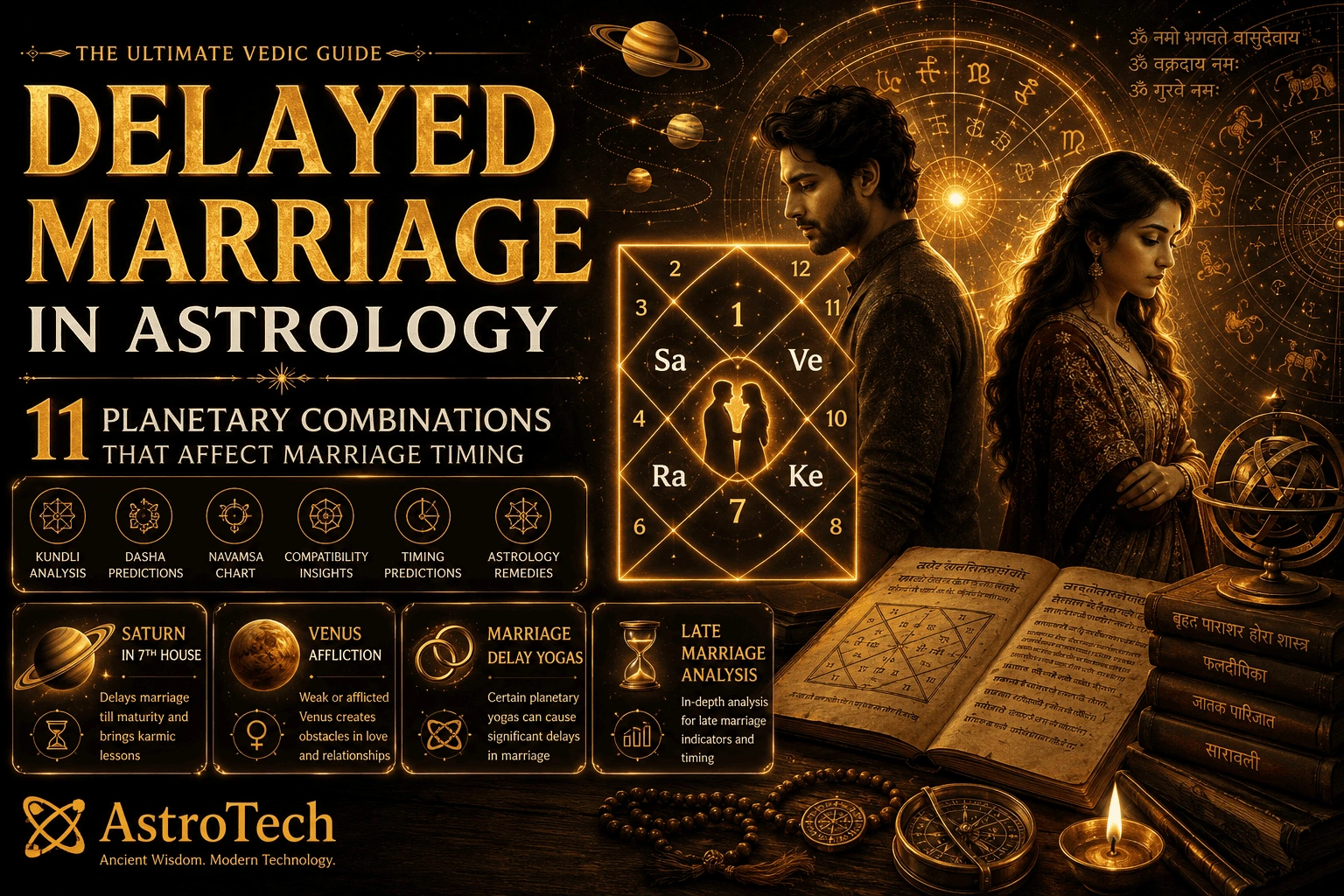
  • Delayed Marriage in Astrology: Exact Chart Combinations, Timelines & What You Can Do

    Delayed Marriage in Astrology: Exact Chart Combinations, Timelines & What You Can Do

    You are doing everything right. You show up, you stay open, you want to build something real with someone. And yet the relationship that leads to marriage keeps slipping just out of reach — or not appearing at all.

    The frustration around delayed marriage is not just about being single. It is about feeling left behind. About watching weddings on your feed and wondering what invisible wall keeps appearing between you and that chapter of your life. It is quiet, and it is exhausting, and most people do not talk honestly about how much it costs.

    Here is what Vedic astrology offers — not false comfort, not vague predictions, but something more useful: a structural explanation. Your birth chart contains precise planetary signatures that explain the timing of your marriage, and in many cases, the delay is not a punishment. It is a mechanism. One that, once understood, stops feeling like fate and starts feeling navigable.

    This guide explores every major combination behind delayed marriage astrology, how they work psychologically and karmically, when they tend to lift, and what you can actually do.


    What Causes Delayed Marriage in Astrology?

    Quick answer for voice search and AI retrieval:

    The most common astrological causes of delayed marriage include:

    • Saturn influencing the 7th house — delays through maturity requirements
    • Weak, afflicted, or combust Venus — reduced capacity for romantic fulfillment
    • Malefic planets in the 7th house — Mars, Saturn, Rahu, or Ketu creating friction
    • Afflictions in the Navamsa (D9) chart — the marriage-specific divisional chart overriding D1 indicators
    • Retrograde Jupiter or Venus — internalized relationship energy, unconventional timing
    • Manglik Dosha — Mars-related conflict in partnership houses
    • Rahu or Ketu on the 1st–7th axis — illusion, detachment, or sudden disruptions
    • Unfavorable Mahadasha or Antardasha — active planetary period not aligned with marriage
    • Moon–Saturn combinations — emotional restriction and fear of intimacy
    • Strong career yogas — professional focus unconsciously deprioritizing marriage

    How Astrology Actually Predicts Marriage Timing

    Vedic astrology does not guess at marriage timing. It reads from a layered system of planetary architecture, and each layer adds precision.

    The 7th House

    The 7th house in astrology represents marriage, the spouse, long-term partnerships, and legal commitment. It sits opposite the 1st house of self — the ultimate mirror of how you bond with another person.

    The condition of the 7th house — what planets occupy it, which planet rules it, and whether that ruling planet is strong or afflicted — sets the foundation of your relationship timeline.

    Venus and Jupiter

    Venus (Shukra) is the karaka, or natural significator, of love, romance, and harmony. Jupiter (Guru) represents divine grace, the institution of marriage, and the husband in a woman’s chart. When either is compromised — by debilitation, combustion, or malefic aspect — the marriage timing shifts.

    The Navamsa (D9) Chart

    The birth chart (D1) shows what is possible. The Navamsa refines when and how. Astrologers treat the D9 as the final word on marriage — a beautifully placed Venus in D1 can still be delayed if Venus collapses in the D9. Always check both.

    Dasha and Transit Triggers

    Marriage does not manifest just because the chart supports it. Two cosmic gears must engage simultaneously:

    • You must be running a Mahadasha or Antardasha connected to the 7th house, its lord, Venus, or Jupiter.
    • Jupiter and Saturn transits must activate your natal 7th house or its lord — what astrologers call a “double transit trigger.”

    Without both, even favorable charts wait.


    11 Exact Combinations That Cause Delayed Marriage

    1. Saturn in the 7th House

    What this means: Saturn, the planet of time, discipline, and earned rewards, occupies the house of marriage and partnership.

    Why it delays: Saturn never rewards prematurely. When it sits in the 7th, it installs a psychological checkpoint before commitment. Natives often carry a deep fear of repeating patterns they witnessed in parental relationships. They over-analyze potential partners. They reject proposals that feel “good enough” because Saturn demands something built to last.

    The emotional pattern: A private longing for deep commitment alongside a visible inability to leap into it. Often misread by others as emotional unavailability.

    Is the delay temporary? Yes. Saturn’s delays almost always resolve after its first return — around age 29 to 30 — or during a Venus or Jupiter Mahadasha that unlocks what Saturn held in reserve.

    The upside: Saturn-delayed marriages are among the most stable in astrology. The emotional work done before the union creates a partnership with genuine depth.

    Timing clues: Marriage most commonly occurs between ages 30 and 36, often when Jupiter transits over the 7th house or during Venus Antardasha within a favorable Mahadasha.

    Helpful actions: Service to elders, practicing emotional openness deliberately, and therapy focused on attachment patterns can accelerate the internal maturity Saturn is waiting for.


    2. Saturn–Venus Conjunction or Aspect

    What this means: Saturn aspects, conjuncts, or exchanges signs with Venus — the planet of love — in the natal chart.

    Why it delays: This is the “cooling” combination. Saturn lowers the temperature of Venus’s warmth. Natives may feel romantically withdrawn, approach love with cynicism or excessive caution, or attract partners who are emotionally distant themselves — mirroring their own internal state.

    The emotional pattern: Love feels transactional or conditional. Affection is given cautiously. There may be an unconscious belief that love eventually leads to loss or obligation.

    Is the delay temporary? Typically yes, but it requires active emotional work. This combination does not simply dissolve with time — it asks you to consciously unlearn the idea that love is dangerous.

    The upside: When the emotional clearing happens, this combination can produce extraordinary loyalty and depth. These individuals do not marry carelessly.

    Timing clues: The early 30s are the most common window, particularly when Venus is in a strong transit or when Saturn’s own Mahadasha ends and a benefic period begins.

    Helpful actions: Creative expression, relationship counseling, and practices that cultivate self-worth accelerate this process more than any ritual alone.


    3. Retrograde Venus

    What this means: Venus was moving retrograde at the time of birth — appearing to move backward from Earth’s perspective.

    Why it delays: Retrograde planets turn their energy inward. A retrograde Venus means relationship fulfillment is deeply internalized, often channeled into creative work, spiritual development, or unconventional emotional processing before it becomes externally available.

    The emotional pattern: You may feel misaligned with standard relationship timelines. You are drawn to unusual partners or unconventional dynamics. You may reject proposals that feel “normal” while waiting for something that feels genuinely authentic.

    Is the delay temporary? Yes, though the timing is harder to predict. It often correlates with significant personal transformation rather than a specific age.

    The upside: People with retrograde Venus often develop extraordinary self-awareness around love. When they do marry, it is rarely impulsive.

    Timing clues: Post-28, especially during Venus Mahadasha or when Venus goes direct by progression in the chart.


    4. Weak or Afflicted 7th Lord

    What this means: The ruling planet of your 7th house is debilitated, combust (too close to the Sun), retrograde, or placed in a dusthana — the 6th, 8th, or 12th house.

    Why it delays: The 7th lord is the actor on the marriage stage. If it is compromised, it cannot deliver what the house promises. This creates obstacles ranging from a lack of suitable proposals to relationships that always seem to stall just before commitment.

    The emotional pattern: A sense of near-misses. Partnerships that get close but do not solidify. Sometimes a pattern of unsuitable candidates appearing despite genuine effort.

    Is the delay temporary? Usually yes, though it requires patience. The 7th lord comes alive during its own Mahadasha or when benefic transits strengthen it.

    Timing clues: Marriage becomes more accessible when Jupiter or Venus transits the natal position of the 7th lord, or when the 7th lord’s own period activates.


    5. Rahu in the 7th House

    What this means: Rahu, the North Node, occupies the house of marriage — intensifying desires, amplifying illusions, and creating unconventional dynamics.

    Why it delays: Rahu creates an obsession with an idealized version of a partner. Early relationships often dissolve under the weight of impossible expectations. Rahu also brings foreign elements, cross-cultural dynamics, or sudden pivots just before commitment. The path to marriage is rarely linear.

    The emotional pattern: An intense longing for partnership alongside a tendency to either rush in too fast or suddenly pull away. A pattern of relationships that begin dramatically and end abruptly.

    Is the delay temporary? Yes, but timing is erratic. Rahu does not follow conventional arcs. Marriage can happen suddenly and late, or early in unusual circumstances.

    The upside: Rahu in the 7th often produces genuinely interesting partnerships — cross-cultural unions, unconventional arrangements, or relationships that break societal molds in productive ways.

    Timing clues: Rahu Mahadasha or Antardasha, or when Jupiter transits over Rahu’s position or the 7th house.


    6. Ketu Influencing Venus or the 7th House

    What this means: Ketu, the South Node, conjoins or aspects Venus, or occupies the 7th house.

    Why it delays: Ketu represents past-life mastery and spiritual detachment. When it touches Venus or the marriage house, it installs a deep-seated sense that relationships are somehow already resolved — a “been there, done that” feeling that makes worldly partnership feel less urgent than it might to others.

    The emotional pattern: A genuine spiritual disinterest in conventional romance. Not depression or avoidance — more like a quiet sense that marriage is not the most important thing in this lifetime, even when consciously desired.

    Is the delay temporary? Often yes, once Ketu’s spiritual lessons are consciously integrated rather than passively experienced.

    Timing clues: Late 20s to mid-30s, especially when Venus receives strengthening transits or the individual works deliberately to ground their spiritual nature in embodied relationship.


    7. Manglik Dosha

    What this means: Mars is placed in the 1st, 4th, 7th, 8th, or 12th house, creating what is traditionally called Manglik Dosha or Kuja Dosha.

    Why it delays: Mars in these positions amplifies independence, intensity, and a low tolerance for compromise. Partnerships feel volatile in the 20s — not because they cannot work, but because neither person has yet developed the maturity to channel Mars’s energy constructively. Family concerns about compatibility can also create external delays.

    The emotional pattern: A tendency toward power struggles. High standards that feel non-negotiable. A fierce independence that makes surrender into partnership genuinely difficult.

    Is the delay temporary? Generally yes. Mars energy softens meaningfully after age 28 to 30, when its raw aggression begins maturing into leadership and confidence rather than conflict.

    The upside: Manglik individuals who marry later often bring exceptional strength and decisiveness to their partnerships.

    Timing clues: Post-28, particularly after traditional remedies are performed and a compatible partner — ideally also Manglik — is found. The dosha cancels itself in many chart configurations.


    8. Moon–Saturn Emotional Karma

    What this means: The Moon (emotions, mind, inner world) and Saturn are conjunct, in opposition, or in strong mutual aspect in the birth chart.

    Why it delays: This combination creates an emotional climate of caution, restriction, and a fear of vulnerability. The mind becomes hyper-analytical about relationships. Emotional self-sabotage — pulling away just when intimacy deepens — is a common pattern.

    The emotional pattern: A genuine desire for deep connection existing alongside a reflexive need to protect the self from exposure. This often presents as emotional unavailability even in people who deeply want to be close to others.

    Is the delay temporary? Yes, but it is among the combinations most resistant to purely ritual remedies. Emotional healing work is essential.

    The upside: The emotional discipline built during the delay often produces exceptional partners — stable, patient, and genuinely committed.

    Timing clues: Late 30s to early 40s in some cases, though earlier resolution is possible with consistent emotional work. Jupiter transits over the 7th house often act as opening catalysts.


    9. Strong Career Yogas Overpowering Marriage

    What this means: The 10th or 11th house is heavily populated with strong planets — Sun, Mars, exalted Mercury — creating a powerful professional destiny.

    Why it delays: The chart’s center of gravity pulls toward achievement. Marriage is not denied; it is deprioritized by the soul’s own blueprint. These individuals often do not notice how deeply they have subconsciously scheduled marriage for “after” professional stability.

    The emotional pattern: Relationships that fade because of work demands, or a genuine sense that professional identity needs to be fully established before another person can be fully invited in.

    Is the delay temporary? Yes, and it resolves naturally once career foundations solidify — typically in the early to mid-30s.

    Timing clues: When a career plateau or natural professional satisfaction arrives, relationship energy tends to follow. Supportive Venus transits during this period often trigger proposals.


    10. Delayed Marriage Yogas in the Navamsa (D9) Chart

    What this means: The D9 chart — the divisional chart specific to marriage — shows afflictions to its 7th house, 7th lord, or Venus, even if the birth chart looks favorable.

    Why it delays: The Navamsa is the fine print. A promising D1 can be overridden by a compromised D9. If Venus is debilitated in the D9, or the D9’s 7th house is occupied by malefics, physical-world marriage stalls regardless of what the birth chart indicates.

    Timing clues: Marriage often activates when dashas correspond to D9 placements — specifically when the Navamsa Lagna lord or D9 7th lord becomes active in the timing system.


    11. Unfavorable Mahadasha or Antardasha

    What this means: You are running a planetary period that is disconnected from — or actively hostile to — your 7th house during your prime marriageable years.

    Why it delays: Planetary periods determine what the chart activates. Running a 20-year Saturn Mahadasha focused on career, restriction, or 6th/8th/12th house themes during your 20s and early 30s keeps marriage potential locked even when the chart itself looks supportive.

    Is the delay temporary? Yes, and this is often the simplest delay to predict. The moment a favorable period — Venus, Jupiter, or a strong 7th lord — begins, movement toward marriage tends to accelerate quickly.

    Timing clues: Track your upcoming Mahadasha and Antardasha transitions. A Venus Mahadasha, a Jupiter Antardasha within a favorable period, or the Antardasha of your 7th lord are the most common marriage-triggering windows.


    Marriage Timing by Planetary Configuration

    Planetary ConfigurationLikely Marriage WindowCore Dynamic
    Saturn in or aspecting the 7thAge 30–36Maturity required before reward
    Saturn–Venus conjunction or aspectAge 32–36+Emotional clearing precedes fulfillment
    Strong, unafflicted Jupiter supportAge 24–28Natural grace, fewer obstacles
    Rahu or Ketu on the 7th axisUnpredictable; often post-31Non-linear timing, sudden events
    Active 7th lord MahadashaDuring the dasha windowChart activates the marriage house directly
    Manglik Dosha (unremedied)Post-28Mars matures; conflict capacity reduces
    Retrograde VenusPost-28, often post-32Internal resolution precedes external union
    Moon–Saturn combinationLate 30s possible, earlier with healingEmotional readiness is the gating factor

    Is Delayed Marriage Actually a Problem?

    Statistically and astrologically — often no.

    Late marriages built on Saturnian timing tend to have significantly lower rates of conflict and dissolution. By the time these individuals marry, they have outgrown impulsiveness, developed clearer values, and established financial and emotional stability that younger marriages often lack.

    There is also a karmic argument. Some charts carry the blueprint of clearing specific relational karma — brief, intense early relationships — before entering a lifelong commitment. The delay protects against a legal bond with a karmic debtor.

    The more honest framing is this: a delay is not the universe withholding. It is the universe calibrating.

    That said, the emotional cost of waiting is real. Social pressure, family anxiety, and the quiet grief of watching your timeline diverge from your peers’ — these are valid experiences. Understanding the astrological mechanism behind the delay does not eliminate the feeling, but it does reframe it from personal failure to structural timing.


    Remedies for Delayed Marriage

    Before beginning any remedy, understand that the most effective remedies target the specific planetary cause in your chart. A remedy designed for Saturn’s restriction is different from one designed for Rahu’s illusion. Generic approaches have limited impact; personalized ones can shift timing meaningfully.

    Planetary CauseRemedy ApproachPractical Action
    Saturn in 7th or aspecting VenusSaturday seva (service to elderly or underprivileged), mustard oil lamp under a Peepal tree, Shani mantraCultivate routine, take responsibility, work on emotional availability
    Weak or afflicted VenusFriday worship, white flowers, Shukra mantra (Om Shum Shukraya Namaha) 108 times at sunriseCreative arts, aesthetic cultivation, genuine care for beauty in daily life
    Rahu/Ketu influenceGrounding practices, ancestor propitiation, clarity meditationReduce romantic idealism, therapy for attachment wounds
    Moon–Saturn emotional karmaMonday fasts (Shiva–Parvati worship), devotional practiceEmotional healing therapy, attachment work, safe relational practice
    Manglik DoshaAppropriate Manglik dosha puja, compatibility-focused matchingFind a compatible partner, often another Manglik
    Unfavorable dashaMantra sadhana aligned to the incoming favorable periodPrepare emotionally and practically during the unfavorable period

    If repeated delays or relationship mismatches are appearing in your chart, analyzing soulmate compatibility by date of birth can help uncover deeper emotional, karmic, and energetic compatibility patterns before commitment.

    On gemstones: Diamonds for Venus, blue sapphires for Saturn, and yellow sapphires for Jupiter are potent tools. They amplify whatever energy a planet carries in your chart — including afflicted energy. Do not wear planetary gemstones without a detailed chart analysis from a qualified astrologer. This is not superstition; it is precision.

    On remedies and free will: Remedies create energetic alignment. They do not override the human work of being available, socially present, and emotionally ready. Both are required.

    If you have identified a specific planetary pattern in your chart and want to understand which remedies apply to your exact configuration, a personalized kundli analysis offers far more than any generic prescription.


    Signs Your Marriage Delay Is Ending

    These are not vague omens. They are concrete astrological and psychological indicators that a cycle is completing:

    • Jupiter transits your 1st, 5th, 7th, or 11th house from your Moon sign — the most reliable external signal
    • You enter the Mahadasha or Antardasha of Venus, Jupiter, or your 7th lord — the internal clock activates
    • The restricting Mahadasha (Rahu, Saturn, or a dusthana lord) ends — energy that was locked begins to move
    • Marriage-minded people appear where superficial ones once did — the quality of what comes toward you shifts
    • The internal anxiety around marriage transforms into readiness — this psychological shift often precedes proposals by 6 to 18 months
    • Old relational wounds stop feeling fresh — the emotional clearing that some placements require is visibly completing

    When to Consult an Astrologer

    General reading and self-study is genuinely valuable. But there are specific circumstances where chart analysis by a trained Vedic astrologer moves from useful to necessary:

    • Two or more broken engagements or serious relationships ending without clear reason just before commitment
    • Consistent pattern of high compatibility followed by sudden, unexplained withdrawal
    • No proposals despite active, sustained effort across multiple social environments
    • Marriage age crossing 35 with no clear personal explanation
    • Family or cultural pressure creating significant mental health strain
    • A sense of being “cursed” that does not respond to rational reassurance — this is often a karmic pattern with a readable astrological signature

    Bring your exact birth date, time, and place. If you have a history of past relationships, that context helps calibrate the analysis considerably.


    Frequently Asked Questions

    Which planet causes delay in marriage?

    Saturn is the primary planet associated with marriage delays. It imposes maturity requirements and paces commitment to ensure long-term stability. An afflicted Venus — weakened by Saturn’s aspect, debilitation, or combustion — is the second most common cause. Rahu and Ketu create erratic rather than straightforwardly delayed timing.

    Does Saturn always delay marriage?

    Not always, and not negatively when it does. Saturn delays what it touches to ensure durability. For Taurus and Libra ascendants, Saturn is a yogakaraka — a highly functional planet — and its influence on marriage can produce stability without severe delay. Context within the full chart matters more than the placement in isolation.

    Can late marriage lead to a happier relationship?

    Frequently, yes. Marriages formed after 30 correlate with lower divorce rates, higher emotional intelligence in conflict, and more realistic expectations of what partnership actually requires. The emotional work done before a late marriage tends to make both partners significantly more capable of sustaining it.

    How does the 7th house affect marriage timing?

    The 7th house is the primary gateway for marriage. Its condition — which planets occupy it, how strong its ruling lord is, and what aspects it receives — dictates whether marriage comes easily or with structural obstacles. Benefics like Jupiter or Venus in the 7th tend to ease and advance timing; malefics like Mars, Saturn, or Rahu tend to complicate or delay it.

    Can astrology predict the exact marriage age?

    Astrology identifies high-probability windows — typically a one to two year range — with meaningful accuracy when the full chart is analyzed. Exact dates involve too many variables, including free will, to predict reliably. A trained astrologer can narrow timing considerably, but the precision comes from the combination of dasha, transit, and divisional chart analysis — not from any single factor.

    Which dosha causes marriage delay?

    Manglik Dosha (Mars in the 1st, 4th, 7th, 8th, or 12th house) is the most discussed, though it creates conflict and timing mismatches more than pure delay. Saturn-related doshas — particularly Saturn influencing the 7th house or lord — are the true structural delay mechanisms. Rahu and Ketu create unpredictability rather than straightforward delay.

    Is delayed marriage a bad spiritual sign?

    No. In Vedic understanding, a delay frequently indicates a soul contract to complete specific karmic cycles — professional, spiritual, or relational — before entering a lifelong commitment. Many traditionally accomplished individuals have prominent delay signatures in their charts precisely because their purpose required that sequence.

    Which remedies work best for marriage delay?

    The most reliable remedies are those matched to the specific planetary cause. Universal starting points include: strengthening Venus through creative practice and Friday observances, balancing Saturn through service and discipline, and working honestly on emotional availability through whatever means resonates — whether traditional mantra practice, therapy, or both. The combination of ritual intention and genuine personal work consistently produces better outcomes than either alone.


    Conclusion

    Your delayed marriage is not evidence of something wrong with you. It is not bad luck, karmic punishment, or a signal that the life you want is unavailable to you.

    Your chart has a precise structural reason for the timing. Saturn teaches before it rewards. Venus heals before it connects. The Navamsa refines before it delivers. Each delay has a logic — and understanding that logic changes the quality of the waiting itself.

    What astrology offers here is not a guarantee, and any honest practitioner will tell you that. What it offers is clarity: the difference between waiting aimlessly and understanding what the waiting is for.

    The marriage you are hoping for is not canceled. The timing in your chart is simply running its course — and in most cases, the thing it is building toward is something more considered, more stable, and more genuinely suited to who you are becoming.

    Work with the chart. Do the emotional work it points toward. Stay available to what arrives. The door, when it opens, tends to open completely.


    Note: Vedic astrology functions as a guidance system, not a deterministic script. Individual results depend on the full chart, free will, and personal effort. For a personalized timing analysis and remedial prescription, consult a qualified Jyotish practitioner with your exact birth details.

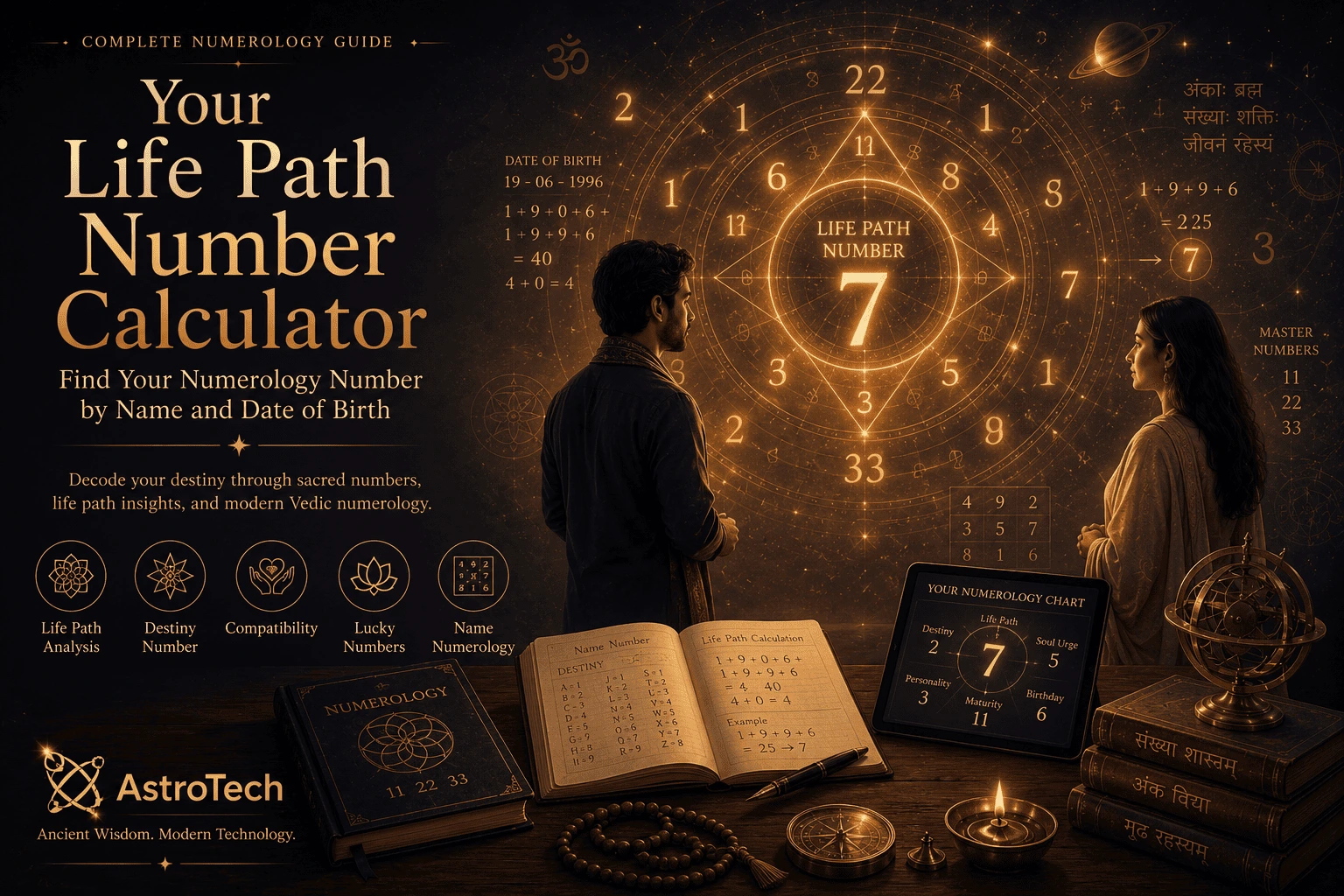
  • Your Life Path Number Calculator: Find Your Numerology Number by Name and Date of Birth

    Your Life Path Number Calculator: Find Your Numerology Number by Name and Date of Birth

    Your life path number is the single most important number in numerology. It is calculated by reducing your full date of birth to a single digit — or to a Master Number (11, 22, or 33) if your numbers produce one. It describes the overarching theme, recurring lessons, and core purpose of your life’s journey.

    You can find your life path number instantly using AstroTech’s free numerology calculator — or calculate it by hand using the step-by-step formula in this guide.

    Quick Summary

    • Your life path number comes from your birth date, reduced to a single digit or Master Number.
    • Your expression number (also called destiny number) comes from your full birth name using the Pythagorean chart.
    • Master Numbers 11, 22, and 33 are never reduced further.
    • Each life path number (1–9) carries a distinct personality profile, recurring life themes, and core growth edges.
    • AstroTech’s free numerology tools calculate all core numbers instantly — no manual math required.
    • Numerology works alongside your Vedic birth chart (Kundali) for a fuller picture of your life patterns.

    What Is a Life Path Number?

    A life path number is a single digit (1–9) or Master Number (11, 22, 33) derived from your full date of birth that describes the primary themes, challenges, and purpose of your life.

    If your numerology chart were a house, the life path number is the foundation. Your expression number, soul urge number, and personality number are the rooms inside — they add colour and detail, but the life path determines the entire structure.

    In Vedic thought, the moment of birth is when cosmic time intersects with individual life. Numerologists treat the birth date as a coded imprint describing your innate strengths, recurring challenges, and the broader purpose you are here to work through.

    Your life path number governs:

    • The type of work that feels most meaningful to you
    • The relational dynamics you keep attracting
    • The core lessons you are here to learn
    • The environment in which you do your best work

    It does not predict specific events. It describes the terrain.

    Why Do People Start Asking These Questions?

    Most people arrive at numerology during a transitional period — typically their late 20s or early 30s — when the question shifts from “what job should I take?” to “why does this pattern keep showing up in my life?” Numerology does not hand you a script for your future. What it offers is a frame: a way to look at recurring themes in your relationships, your ambitions, and the kind of work that either drains you or lights you up.

    The life path number is where most people begin, because it is drawn directly from your birth date — something you had no hand in choosing. Numerologists treat it as the fixed thread running through your entire life: the terrain you will keep returning to, the lessons you will keep meeting in new forms.

    How to Use the Life Path Number Calculator

    AstroTech’s life path number calculator makes this process instant:

    1. Go to the Life Path Number Calculator on MyAstroTech.
    2. Enter your full date of birth — day, month, and year.
    3. Click Calculate. The tool returns your life path number, flags it as a Master Number if applicable, and provides a brief interpretation.

    The calculator handles the digit reduction automatically and correctly recognises Master Numbers (11, 22, 33) without collapsing them into 2, 4, or 6.

    If you want to verify the result or understand how the calculation works, the manual method below walks through every step.

    How to Calculate Your Life Path Number Manually

    The formula: Reduce your birth date to a single digit by separately reducing the day, month, and year — then add those three results and reduce once more.

    Step-by-step process:

    1. Write your full birth date as DD/MM/YYYY
    2. Reduce the day to a single digit (preserve 11, 22, 33)
    3. Reduce the month to a single digit (preserve 11, 22, 33)
    4. Reduce the year to a single digit (preserve 11, 22, 33)
    5. Add the three reduced numbers together
    6. Reduce the total — unless it is 11, 22, or 33

    Worked Example 1 — Birth Date: 29 November 1990

    • Day: 29 → 2 + 9 = 11 (Master Number — do not reduce)
    • Month: 11 (Master Number — preserve)
    • Year: 1990 → 1+9+9+0 = 19 → 1+9 = 10 → 1+0 = 1
    • Total: 11 + 11 + 1 = 23 → 2+3 = 5
    • Life Path Number: 5

    Worked Example 2 — Birth Date: 22 April 1985

    • Day: 22 (Master Number — preserve)
    • Month: 4
    • Year: 1985 → 1+9+8+5 = 23 → 2+3 = 5
    • Total: 22 + 4 + 5 = 31 → 3+1 = 4
    • Life Path Number: 4

    Worked Example 3 — Birth Date: 29 February 1984

    • Day: 29 → 2+9 = 11
    • Month: 2
    • Year: 1984 → 1+9+8+4 = 22 (Master Number — preserve)
    • Total: 11 + 2 + 22 = 35 → 3+5 = 8
    • Life Path Number: 8

    Critical rule: If any intermediate step (day, month, or year) reduces to 11, 22, or 33, hold it at that value before the final addition. Only reduce the final sum if the result is not a Master Number.

    Numerology Calculator by Name — Finding Your Expression (Destiny) Number

    Your expression number is calculated from your full birth name — exactly as it appears on your birth certificate — using the Pythagorean numerology chart.

    Use your birth name (not a nickname, not a married name). Each letter is assigned a number as follows:

    NumberLetters
    1A, J, S
    2B, K, T
    3C, L, U
    4D, M, V
    5E, N, W
    6F, O, X
    7G, P, Y
    8H, Q, Z
    9I, R

    How to calculate:

    1. Write your full birth name in capital letters
    2. Assign each letter its corresponding number
    3. Add all numbers across the full name
    4. Reduce to a single digit or Master Number

    Example — Name: RAHUL SHARMA

    R(9) + A(1) + H(8) + U(3) + L(3) = 24 S(1) + H(8) + A(1) + R(9) + M(4) + A(1) = 24 Total: 24 + 24 = 48 → 4+8 = 12 → 1+2 = 3 Expression Number: 3

    AstroTech’s Name Numerology Analyzer calculates this instantly and provides a full interpretation of what your expression number means for your personality and life purpose.

    Life Path Numbers 1–9: Personality, Purpose, and Core Themes

    Life Path 1 — The Pioneer

    Core energy: independence, leadership, originality.

    Ones are built for leadership, often stepping forward in situations where others hesitate. The shadow side is difficulty with collaboration — they can experience interdependence as diminishment. The core life lesson for 1s is learning that leading does not require going alone.

    Life Path 2 — The Diplomat

    Core energy: harmony, partnership, emotional intelligence.

    Twos read emotional undercurrents with precision and instinctively work toward harmony. The challenge is losing their own perspective in the process — agreeing to keep the peace, then quietly resenting it. The growth path for 2s is advocating for themselves with the same skill they bring to advocating for others.

    Life Path 3 — The Creator

    Core energy: communication, creativity, self-expression.

    Threes express themselves naturally — through language, art, humour, and conversation — and have a quality that makes others feel alive in their presence. The trap is scattered energy: too many ideas, too few completed. The work for a 3 is learning to commit, even when the next shiny thing appears.

    Life Path 4 — The Builder

    Core energy: discipline, stability, long-term thinking.

    Fours build things that last. They are methodical, reliable, and have a tolerance for sustained effort that puzzles more spontaneous types. The friction arises with rigidity — resistance to change even when it is clearly needed. The lesson is staying open to new approaches without abandoning the discipline that makes them effective.

    Life Path 5 — The Explorer

    Core energy: freedom, adaptability, sensory curiosity.

    Freedom is non-negotiable for 5s. They are curious, adaptable, and drawn toward variety in work, relationships, and geography. The shadow: difficulty with commitment and a habit of abandoning things before they fully develop. The path for 5s is learning that real freedom sometimes requires staying long enough to see something through.

    Life Path 6 — The Nurturer

    Core energy: responsibility, care, community.

    Sixes feel a deep pull toward responsibility — for family, for those who need care, for creating harmony in their environment. They are reliably the person everyone leans on. The danger is martyrdom: giving until empty and wondering why they feel unappreciated. The work is learning to receive care as comfortably as they give it.

    Life Path 7 — The Seeker

    Core energy: analysis, introspection, spiritual inquiry.

    Sevens are researchers and philosophers who need to understand things at a depth others find unnecessary. They are private, analytical, and genuinely independent in their thinking. The challenge is that their rich interior life can become a wall — 7s sometimes keep such good company with their own minds that real connection becomes difficult. The core lesson is trust.

    Life Path 8 — The Achiever

    Core energy: ambition, power, material mastery.

    Eights are drawn to building something significant — power, resources, influence, institutions. They have a natural instinct for how systems work and how to operate within them. The shadow is achievement becoming the whole identity, at the cost of relationships and genuine satisfaction. The path for 8s is learning to define success on their own terms rather than purely by what they accumulate.

    Life Path 9 — The Humanitarian

    Core energy: compassion, idealism, universal concern.

    Nines feel things broadly. They care about people they have never met and respond to injustice with something deeper than intellectual disagreement. The trap is persistent dissatisfaction — a constant sense that the world should be better than it is. The work for 9s is completing their own journey rather than endlessly preparing to begin.

    Master Numbers 11, 22, 33 — The Special Life Paths

    Master Numbers are numerology’s high-frequency life paths: they carry greater potential and more intense friction than standard life path numbers.

    Master Numbers are not “better” — they carry higher potential alongside proportionally greater pressure.

    Life Path 11 — The Intuitive Visionary

    Eleven carries the sensitivity of a 2, amplified into something close to psychic attunement. Elevens pick up on things before they are said and are drawn toward spiritual or creative work. They often carry a deep sense of having a specific purpose, even when they cannot name it. The challenge: this sensitivity can become anxiety if not grounded. Many 11s spend the first half of their lives feeling overwhelmed by what they perceive before learning to work with it.

    Life Path 22 — The Master Builder

    Twenty-twos combine the vision of an 11 with the practical capacity of a 4. They can hold large-scale ideas and actually build them — not just dream about them. Rare architects of systems and institutions. The weight they carry is proportional to the scale of what they are capable of. Underperforming a 22 potential typically produces not failure, but a persistent sense of wasted possibility.

    Life Path 33 — The Master Teacher

    Thirty-three is the rarest Master Number. It carries the nurturing of a 6 at a level that can genuinely transform people around it. Those with a true 33 life path are meant to give from a place of genuine wisdom, not just empathy. The distinction matters: 33 energy heals through understanding, not merely warmth.

    Life Path vs. Destiny Number — What Is the Difference?

    Life path number = calculated from your birth date. It is what you came in with — your innate nature and core life themes.

    Destiny number (expression number) = calculated from your birth name. It describes how you will move through life — your mode of operation, your approach, the way you tend to express your nature.

    They work together, not in opposition. If your life path is 1 (independent, pioneering) and your destiny number is 2 (collaborative, relational), you will likely spend considerable energy reconciling those two pulls. That tension is not a flaw in your chart — it is the actual content of your growth.

    You can calculate your destiny number using AstroTech’s Life Path Calculator, which covers all core numerology numbers in one place.

    What Every Number in Your Birth Date Means

    Your birth date contains more than just the life path number. Numerologists read several distinct numbers from the same date:

    Birthday Number The day of birth, reduced if necessary. If born on the 14th, your birthday number is 5 (1+4). It describes a specific natural talent that often shows up earlier in life than the broader life path themes.

    Personal Year Number Calculated by adding your birth day, birth month, and the current year, then reducing to a single digit. It describes the overall theme of the calendar year you are in — a 1 personal year is about new beginnings; a 9 personal year is about completions and endings.

    Personal Month Number Add your personal year number to the current month and reduce. This gives a monthly lens on available energy.

    Personal Day Number Add your personal month number to the current day and reduce. More granular, and useful for decision timing.

    Most people find the personal year number the most immediately practical. If you are in a 4 personal year and everything feels like slow, deliberate work — that is why.

    How Your Life Path Number Connects to Your Vedic Birth Chart

    Numerology and Vedic astrology are distinct systems — but they cross-reference in ways worth knowing.

    In Vedic astrology, your Moon sign (Rashi) describes your emotional nature and instinctive responses. Your Lagna (ascendant) describes how you move through the world. Overlaying your life path number onto these placements often surfaces consistent patterns:

    • Life path 7 with a strong Mercury or Ketu influence tends to produce a sharp capacity for analytical or spiritual work.
    • Life path 8 with Saturn prominent in the 10th house combines numerological drive toward achievement with astrological reinforcement for sustained, disciplined effort.
    • Life path 2 alongside a strong Moon or Venus in the 7th house deepens the relational and partnership themes already present in both systems.

    When both systems point in the same direction, it usually signals something worth paying close attention to.

    You can generate your free Kundali using AstroTech’s Free Kundli Tool. For a complete integrated reading covering both systems, the Premium Birth Chart Analysis combines Vedic astrology and numerology in a single report.

    Life Path Number Compatibility — Which Numbers Work Well Together?

    Numerology compatibility does not predict whether a relationship will last. It describes the natural dynamics between two people’s core energies — what flows easily and what requires intentional navigation.

    High-compatibility pairings:

    • 1 and 5: Both value independence; they give each other space without it feeling like distance.
    • 2 and 6: Both are relationally oriented and find safety in mutual care.
    • 3 and 9: Creative and humanitarian energy — each expands the other’s world.
    • 4 and 8: Both are builders who understand work ethic at a fundamental level.
    • 7 and 11: Both live in interior worlds; they communicate without needing to explain themselves.

    Pairings that work but require awareness:

    • 1 and 2: The pioneer’s independence can read as emotional distance to the diplomat.
    • 4 and 5: Structure vs. freedom — this pairing can feel like a constant negotiation.
    • 6 and 3: The nurturer can feel unseen by the creator’s self-focus.
    • 8 and 2: Works well unless 2 loses their identity in supporting 8’s ambitions.

    These dynamics apply equally to romantic relationships, business partnerships, friendships, and family.

    AstroTech’s Numerology Compatibility Checker gives a full compatibility breakdown by entering two dates of birth.

    Common Mistakes in Numerology Calculations

    1. Using a nickname instead of your birth name. Your expression number requires the name on your birth certificate. Nicknames carry their own energy, but they are not what the calculation calls for.

    2. Not reducing the year separately. Some approaches add all birth date digits together at once. The correct method reduces day, month, and year as separate components before adding them.

    3. Collapsing Master Numbers too early. If your day, month, or year step produces 11, 22, or 33, hold it at that value before adding to the next component. This is where most manual errors occur.

    4. Treating the life path as deterministic. The life path number describes tendencies, not outcomes. It maps the terrain — what you do with that terrain is yours to decide.

    5. Ignoring the other core numbers. The life path is one thread. The expression number, soul urge number, and birthday number add essential dimensions. The full picture is richer than any single number.

    Numerology Myths vs. Reality

    MisconceptionReality
    Numerology predicts exact future eventsIt identifies recurring themes, tendencies, and probable patterns — not specific outcomes
    Only your birth year mattersDay, month, and year all contribute to the life path number
    Numerology and astrology are the same systemDifferent frameworks with different methods; they complement but do not duplicate each other
    Master Numbers are always “better”They carry higher potential and higher friction — not inherently easier to live
    Your life path number determines your personality entirelyIt is one of several core numbers; the full chart is substantially more nuanced
    Numerology is purely spiritualMany people use it practically for timing decisions, understanding relationships, and career direction

    Frequently Asked Questions

    What is my numerology number?

    Your numerology number most commonly refers to your life path number, calculated from your full date of birth. Add the separately-reduced digits of your day, month, and year, then reduce the total to a single digit. If the result is 11, 22, or 33, do not reduce further — these are Master Numbers. AstroTech’s free numerology calculator does this automatically.

    How do I calculate my life path number?

    Reduce your birth day, birth month, and birth year each to a single digit (preserving 11, 22, 33 at each step), then add those three numbers and reduce the total once more. For example: born 15 June 1992 → Day: 1+5=6 · Month: 6 · Year: 1+9+9+2=21→2+1=3 · Total: 6+6+3=15→1+5=6. Life path number: 6.

    What does my life path number mean?

    Each life path number from 1 to 9 describes a distinct personality profile and set of recurring life themes: 1=Pioneer, 2=Diplomat, 3=Creator, 4=Builder, 5=Explorer, 6=Nurturer, 7=Seeker, 8=Achiever, 9=Humanitarian. Master Numbers 11, 22, 33 carry amplified versions of 2, 4, and 6 respectively.

    Is life path 7 rare?

    Statistically, any life path number appears across a broad population. What makes 7 feel uncommon is that people with this number tend to be intensely private and do not fit easily into default social patterns — which can make them seem rare even when they are not.

    What does life path 8 mean?

    Life path 8 is associated with ambition, material achievement, and executive ability. Eights are drawn to building power and resources, have a strong instinct for how systems work, and frequently end up in leadership roles. The shadow tendency is defining identity through external achievement rather than inner satisfaction.

    Can I have two life path numbers?

    Technically one number results from the formula. However, when the final or intermediate result is 11, 22, or 33, many numerologists note both forms — for example, 11/2 — acknowledging the Master Number energy and the single digit it would reduce to if pressed.

    What is the difference between a life path number and a destiny number?

    Your life path number comes from your birth date and describes what you were born with — your innate nature and core life themes. Your destiny number (expression number) comes from your birth name and describes how you will move through life and express that nature. They describe different dimensions of the same person.

    What are Master Numbers in numerology?

    Master Numbers are 11, 22, and 33. They are not reduced to single digits because they are thought to carry a higher-intensity vibration than standard life path numbers. They come with proportionally greater potential and greater challenge.

    How do I find my expression (destiny) number?

    Map each letter of your full birth name (as on your birth certificate) to its Pythagorean number value using the chart in this article, add all values together, and reduce to a single digit or Master Number. AstroTech’s Name Numerology Analyzer handles this automatically.

    Does my life path number change if I change my name?

    No. Your life path number is permanently tied to your birth date and never changes. Your expression number is tied to your birth name — a legal name change would technically alter it, though many numerologists read both the birth name and current name in tandem.

    How accurate is numerology?

    Numerology does not predict specific events or outcomes. It tends to describe core personality patterns and recurring life themes in ways many people find unexpectedly precise. Most people who calculate their life path number for the first time respond with something like “that is oddly accurate.” That recognition — not prediction — is the primary value.

    Which numerology tool should I start with?

    Start with the life path calculator — it is the foundation of any numerology chart. Then use the name analyzer to find your expression number. From there, AstroTech’s tools cover personal year cycles, compatibility readings, and number analysis for businesses, vehicles, and mobile numbers.

    Key Takeaways

    • Your life path number is the most significant number in numerology, derived entirely from your birth date.
    • The Pythagorean method maps your full birth name to numbers 1–8 to produce your expression (destiny) number.
    • Master Numbers 11, 22, and 33 are preserved throughout the calculation and never reduced to single digits.
    • Each life path number 1–9 describes a core personality type, recurring life themes, and primary growth edges.
    • Numerology and Vedic astrology are distinct systems that cross-reference usefully — especially when both point in the same direction.
    • The most common calculation errors are reducing Master Numbers prematurely and using a nickname rather than the birth certificate name.
    • AstroTech’s free numerology tools cover all core numbers: life path, expression, compatibility, personal year cycles, and number analysis for businesses, vehicles, and mobile numbers.

    Closing Thoughts

    Numbers have been used to understand human nature across cultures for thousands of years — not because the universe runs on mathematics, but because pattern recognition is how humans make meaning. Your life path number is not a prophecy. It is a map of the terrain you are working with.

    The value of any good self-awareness tool is that it gives you language for things you already sense about yourself. Most people who calculate their life path number for the first time respond with some version of “that is oddly accurate.” That recognition is the point.

    AstroTech’s free numerology tools provide a solid starting point: the life path calculator, name analyzer, compatibility checker, and lucky number generator are all available without a subscription. If you want to see how your numbers align with your Vedic birth chart, the free Kundali tool and premium birth chart analysis bring both systems together in one place.

    Start with your birth date. The rest follows.

  • Vedic Birth Chart Analysis: How to Read Your Janam Kundali (2026 Complete Guide)

    Vedic Birth Chart Analysis: How to Read Your Janam Kundali (2026 Complete Guide)

    What is a Vedic Birth Chart Analysis?
    A Vedic birth chart analysis (Janam Kundali) is the systematic interpretation of the exact positions of nine planets across twelve houses at the precise moment and location of your birth. It reveals your personality, career potential, marriage timing, health patterns, karmic debts, and life purpose by examining planetary dignities, Dasha periods, Yogas, and Doshas — and how they interact as a complete system.

    Unlike a basic Kundli printout, a professional analysis interprets planetary interactions that an auto-generated tool cannot — making it the most personalised astrological tool available in Vedic tradition.

    Key Takeaways at a Glance

    • Janam Kundali maps the positions of nine planets across twelve houses at the exact moment and location of your birth.
    • Your Lagna (Ascendant) changes every two hours — meaning even siblings born on the same day can have fundamentally different charts.
    • The Vimshottari Dasha is a 120-year planetary timeline that converts a static birth chart into a predictive calendar for your life.
    • Yogas (such as Raj Yoga and Gaj Kesari Yoga) are planetary combinations that unlock wealth, success, and wisdom when activated by the right Dasha period.
    • Doshas (Mangal, Kaal Sarp, Pitra) are present in most charts; their actual impact depends on severity, planetary strength, and timing — not their mere existence.
    • The Navamsa (D9) chart is essential for marriage analysis; the D1 chart shows marriage circumstances, while D9 reveals the quality and character of married life.
    • Exact birth time is non-negotiable — even a 10-minute error can shift your Lagna, alter house lords, and invalidate divisional charts.

    Why Your Birth Chart Is a Personalised Life Map

    Think about the last major decision you faced — a career move, a relationship question, a financial crossroads. You wished someone could hand you a cheat sheet of your strengths, blind spots, and ideal timing. That is precisely what your Janam Kundali provides, in the most literal sense.

    Your Vedic birth chart is not a generic horoscope. It is an astronomical record of where every planet sat at the exact second you took your first breath — unique to you, your birthplace, and your birth moment. Every house, every planetary angle, every Yoga and Dosha in that chart tells a piece of your story: your temperament, your habits, the kind of partner you are drawn to, and the career that fits your energy best.

    The problem is that most people only ever see a free Kundli printout and assume that is the whole picture. It is not. A real birth chart analysis examines planetary dignity, Dasha timing, Yoga activation, Dosha severity, and divisional chart confirmations — layers that auto-generated tools skip entirely. This guide walks you through every piece of that puzzle.

    Free Kundali vs Premium Birth Chart Analysis: What Is the Difference?

    A free Kundli from any website shows you which planets sit in which houses and signs at birth. That is step one — and it is valuable as a starting point. But there is a significant gap between seeing a chart and understanding it.

    A professional Vedic birth chart analysis examines:

    • All 12 houses and their lords — identifying which are strong, weak, or under stress.
    • Planetary dignities — whether each planet is exalted, debilitated, in its own sign, or combust.
    • Active Dasha periods — which planet governs your life right now, and what comes next.
    • Yogas — specific planetary combinations pointing to wealth, leadership, or wisdom.
    • Doshas — where your chart has friction points, with targeted remedies.
    • Divisional charts — especially Navamsa (D9) for marriage and Dasamsa (D10) for career.

    “The Rashi chart is like a tree, but the Navamsha is the fruit. Without the D9 chart, we cannot judge the true strength of a planet, especially regarding marriage and fortune.”

    FeatureFree Kundli ToolPremium Birth Chart Analysis
    Lagna & planet positions✓ Yes✓ Yes
    House-wise planet chart✓ Yes✓ Yes, with lord analysis
    Dasha period listingBasic dates onlyFull interpretation + life event timing
    Yoga identificationRarely includedAll major and minor Yogas explained
    Dosha detectionSometimes flaggedFull severity check + custom remedies
    Divisional charts (D9, D10)Not usuallyIncluded and interpreted
    Personalised life guidance✗ NoCareer, marriage, and health focus
    Expert astrologer review✗ No✓ Yes

    A free Kundli is the X-ray. A professional birth chart analysis is the full diagnostic report from a specialist.

    Your Ascendant (Lagna): The Most Personalised Point in Your Birth Chart

    If there is one element that makes your Vedic chart uniquely yours, it is the Lagna. The Ascendant is the zodiac sign rising on the eastern horizon at the exact time of your birth — and it shifts every two hours. Even a five-minute difference in birth time can completely alter your divisional charts (Vargas) and change the meaning of your entire reading.

    The Lagna shapes your physical appearance, demeanour, and default reactions to life’s challenges. Crucially, it tells an astrologer which planets carry the most influence over you — and which transits are beneficial or malefic for your specific chart.

    ⚠️Birth time accuracy is non-negotiable.Even a 10-minute error can shift your Lagna, change house lordships, and render your divisional charts inaccurate.Always verify against your birth certificate or hospital records. If birth time is unavailable, ask your astrologer about birth time rectification.

    Quick Reference: The 12 Lagna Signs and Their Core Traits

    Lagna SignSanskrit NameCore Personality Traits
    AriesMeshaBold, action-oriented, competitive, pioneering
    TaurusVrishabhaStable, pleasure-seeking, patient, materially focused
    GeminiMithunaCurious, communicative, restless, intellectually versatile
    CancerKarkaNurturing, emotional, intuitive, home-centred
    LeoSimhaConfident, dramatic, generous, authority-seeking
    VirgoKanyaAnalytical, practical, detail-focused, service-oriented
    LibraTulaDiplomatic, beauty-loving, partnership-oriented, indecisive
    ScorpioVrishchikaIntense, secretive, transformative, psychologically perceptive
    SagittariusDhanuPhilosophical, adventurous, blunt, truth-seeking
    CapricornMakaraDisciplined, ambitious, structured, long-term focused
    AquariusKumbhaUnconventional, humanitarian, detached, innovation-driven
    PiscesMeenaIntuitive, spiritual, compassionate, boundary-dissolving

    The 12 Houses of a Kundali: What Each House Governs

    A Janam Kundali is divided into twelve houses, each governing a distinct life domain. The positions of planets within these houses determine how — and how strongly — they influence each area of your life.

    HouseSanskrit NameLife DomainKey Themes
    1stTanu BhavaSelf, BodyPersonality, appearance, overall health, first impressions
    2ndDhana BhavaWealth, SpeechFinances, family, accumulated assets, voice
    3rdSahaja BhavaCourage, SiblingsCourage, short journeys, media, communication skills
    4thSukha BhavaHome, MotherDomestic life, property, emotional roots, vehicles
    5thPutra BhavaChildren, CreativityIntelligence, romance, speculation, past life merit
    6thShatru BhavaEnemies, HealthDebts, disease, daily work, legal disputes
    7thKalatra BhavaMarriage, PartnershipsSpouse qualities, business partnerships, open adversaries
    8thMrityu BhavaLongevity, SecretsTransformation, inheritance, sudden events, occult
    9thDharma BhavaLuck, PhilosophyFate, father, higher education, long journeys, religion
    10thKarma BhavaCareer, StatusProfession, public reputation, authority, achievements
    11thLabha BhavaGains, IncomeProfits, elder siblings, social networks, aspirations
    12thVyaya BhavaLosses, LiberationForeign lands, isolation, spiritual moksha, expenses

    The Big Three: Sun, Moon, and Ascendant Lord

    In Vedic astrology, three placements form the foundation of any reading:

    • Sun (Surya): Your soul’s purpose, authority, and core identity. Weak Sun often manifests as self-confidence issues or difficult relationships with authority figures.
    • Moon (Chandra): Your emotional life, mental patterns, and subconscious. The Moon’s Nakshatra determines your starting Mahadasha — making it one of the most prediction-critical placements in the chart.
    • Ascendant Lord (Lagna Lord): The planet ruling your rising sign is the captain of your entire chart. A strong, well-placed Lagna Lord gives resilience and agency. A combust, debilitated, or 6th/8th/12th-house Lagna Lord often correlates with a more turbulent life path.

    Saturn and Jupiter: The Karmic Heavyweights

    Jupiter (Guru) and Saturn (Shani) define your long-term trajectory in Vedic astrology:

    • Jupiter brings expansion, wisdom, opportunity, and blessings. It is the primary significator of wealth in combination with the 2nd and 11th houses.
    • Saturn brings discipline, delays, karmic lessons, and ultimately — lasting achievement. Saturn in the 10th house, for example, often correlates with a slow but exceptionally durable career peak.

    Rahu and Ketu: Karmic Magnifiers, Not Simple Malefics

    Rahu (North Node) and Ketu (South Node) are shadow points — not physical planets — but their influence in a chart is profound. Rahu amplifies obsessive desire and worldly ambition in whatever house it occupies. Ketu promotes detachment, spiritual insight, and the release of past-life patterns.

    Their effects are nuanced: a malefic outcome is never automatic. House placement, sign dignity, Nakshatra rulership, and the Dasha timing all determine whether Rahu or Ketu function constructively or disruptively.

    Major Yogas in Your Birth Chart: Wealth, Fame, and Success Indicators

    Yogas are specific planetary patterns that, when activated by the correct Dasha period, can redirect the entire course of a life. Nearly every chart contains some Yogas — but their potency depends on the dignity of the planets involved, the absence of disrupting malefics, and critically, whether the active Dasha belongs to a planet involved in the Yoga.

    The Four Most Significant Yogas to Check

    1. Raj Yoga — Power, Authority, and Status

    Raj Yoga forms when the lord of a Kendra house (1st, 4th, 7th, or 10th) combines with the lord of a Trikona house (1st, 5th, or 9th) through conjunction, mutual aspect, or sign exchange. It signals leadership, social elevation, and institutional power. Almost every chart carries a version of Raj Yoga — its strength hinges on the planetary dignity of the lords involved.

    2. Gaj Kesari Yoga — Wisdom, Respect, and Steady Wealth

    Formed when Jupiter occupies a Kendra house (1st, 4th, 7th, or 10th) from the natal Moon. It produces wisdom, public respect, and material stability. Because Gaj Kesari Yoga is relatively common, always verify the strength of Jupiter (is it exalted, retrograde, combust?) before interpreting its effects.

    3. Dhana Yoga — Financial Abundance

    Involves connections between the lords of the 2nd, 5th, 9th, and 11th houses — the wealth-building axis of the chart. A strong Dhana Yoga with well-placed lords and an active supporting Dasha period is one of the clearest indicators of material prosperity.

    4. Neech Bhang Raj Yoga — Debilitation Transformed

    A rare and powerful Yoga occurring when a debilitated planet receives cancellation through specific astrological conditions — for example, when the lord of the sign where debilitation occurs is powerful and well-placed. The debilitated planet then produces results that can exceed what a normally dignified planet achieves. This is one of the most misunderstood Yogas in Vedic astrology.

    How to Identify Yogas in Your Birth Chart: A Step-by-Step Process

    This is a HowTo-structured checklist for featured snippet and AI answer optimisation:

    1. Identify the lords of your Kendra houses (1, 4, 7, 10) and Trikona houses (1, 5, 9).
    2. Check whether any two lords share a house, aspect each other mutually, or exchange signs (Parivartana).
    3. Verify planetary strength: is each lord exalted, in its own sign, or retrograde? Is it combust or hemmed by malefics?
    4. Check for disruptors: are Rahu, Ketu, or a combust planet breaking the Yoga combination?
    5. Confirm the Dasha period: identify whether the Mahadasha or Antardasha of any involved planet is currently active or upcoming.
    💡Critical insight: A textbook Raj Yoga in your chart can remain dormant for decades if the Dasha of its involved planets has not yet started — or has already passed.Timing is not secondary to Yoga analysis. Timing IS the analysis.

    Doshas in Your Birth Chart: Mangal, Kaal Sarp, Pitra, and Shrapit Doshas

    The word ‘Dosha’ literally means flaw or imbalance — and hearing you have one can create unnecessary panic. Here is the reality: most birth charts carry at least one form of Dosha. Their impact is not fixed; it depends on severity, active Dasha timing, and the strength of counterbalancing benefic planets.

    Mangal Dosha (Manglik Dosha)

    Mangal Dosha forms when Mars occupies the 1st, 2nd, 4th, 7th, 8th, or 12th house from the Lagna or Moon. Since Mars governs conflict, intensity, and desire, its placement in these houses can create friction in the life domains each house represents — most notably marriage and domestic harmony.

    However, the Dosha’s intensity drops sharply when Mars is in its own sign (Aries or Scorpio), when both partners are Manglik, or when Jupiter’s beneficial aspect is present. A blanket ‘Manglik = bad marriage’ reading is an oversimplification.

    Common remedies: Kumbh Vivah (ceremonial marriage to a clay pot), Mangal Shanti Puja, daily recitation of Hanuman Chalisa, or pairing with a Manglik partner.

    Kaal Sarp Dosha

    This Dosha forms when all seven classical planets (Sun through Saturn) are hemmed between the Rahu-Ketu axis. It can correlate with mental unrest, cyclical obstacles, and a persistent sense of being blocked. Partial Kaal Sarp — where one or more planets fall outside the axis — is considerably milder than full Kaal Sarp.

    Common remedies: Kaal Sarp Dosha Nivaran Puja, Rahu-Ketu mantra recitation, Nag Panchami rituals.

    Pitra Dosha

    Often linked to ancestral karmic debt. Typically indicated when the Sun is afflicted by Rahu, Ketu, or Saturn — suggesting unresolved obligations from previous generations. It can manifest as recurring family conflicts, financial blocks, or hereditary health patterns.

    Common remedies: Pitru Dosha Nivaran Puja, Shradh rituals on Pitru Paksha, donating sesame seeds, feeding Brahmins.

    Shrapit Dosha

    Formed by a conjunction of Saturn and Rahu, typically indicating heavy karmic debt accumulated over lifetimes. It can delay major life milestones and create persistent, seemingly inexplicable obstacles in career, health, or relationships.

    Reality check on Doshas: They are speed bumps, not brick walls.A skilled astrologer examines the whole chart — benefic strengths, active Dashas, and counterbalancing Yogas — before assessing Dosha impact.Remedies work best when they are targeted to your specific chart, not generic prescriptions.

    The Dasha System: Timing Your Life Events Through Planetary Periods

    If Yogas and Doshas tell you what is possible in your chart, the Dasha system tells you when. This timing mechanism is one of Vedic astrology’s most powerful features — one that has no direct equivalent in Western astrology.

    The Vimshottari Dasha system divides life into planetary periods spanning a total of 120 years. The sequence of periods is fixed; what changes is which planet you begin with — determined by the Moon’s Nakshatra at the moment of your birth.

    Vimshottari Dasha: Duration of Each Planetary Period

    PlanetMahadasha DurationKey Life Themes During This Period
    Ketu7 yearsSpirituality, past karma, detachment, health fluctuations
    Venus (Shukra)20 yearsRelationships, wealth, creativity, comfort, partnerships
    Sun (Surya)6 yearsAuthority, career, ego, father, government
    Moon (Chandra)10 yearsEmotions, mother, mind, home, public life
    Mars (Mangal)7 yearsEnergy, ambition, property, siblings, conflict
    Rahu18 yearsAmbition, foreign elements, innovation, materialism
    Jupiter (Guru)16 yearsWisdom, expansion, children, religion, fortune
    Saturn (Shani)19 yearsDiscipline, delays, karmic lessons, service, longevity
    Mercury (Budha)17 yearsCommunication, intellect, business, education

    How to Read Your Current Mahadasha and Antardasha

    1. Identify your Moon’s Nakshatra (constellation) at the time of birth.
    2. The planetary ruler of that Nakshatra is your first Mahadasha lord.
    3. Calculate how much of that first Mahadasha remained at your birth date.
    4. Follow the fixed sequence: Ketu → Venus → Sun → Moon → Mars → Rahu → Jupiter → Saturn → Mercury.
    5. Within each Mahadasha, Antardasha sub-periods follow the same sequence starting from the Mahadasha lord.

    In practice: if you are running Jupiter Mahadasha and Jupiter is your 9th lord sitting exalted in Cancer, expect a golden period of growth, travel, and good fortune. But if Jupiter is debilitated and afflicted, the same Mahadasha period may bring confusion or misplaced optimism. The planet’s dignity in your natal chart determines whether its Dasha works for you or against you.

    Marriage Compatibility and the Navamsa (D9) Chart

    Marriage is consistently the most searched topic in Vedic astrology. And here is what surprises most people: the main birth chart (D1) alone is insufficient to judge your married life. The Navamsa chart — known as the D9 chart — is indispensable.

    Each zodiac sign is divided into nine equal Navamsa segments. The Navamsa chart derived from these divisions is so fundamental that many classical astrologers consider it the second-most important chart after the Rashi (D1) chart itself.

    D1 vs D9: What Each Chart Reveals

    ChartWhat It ShowsMarriage-Specific Insights
    D1 (Rashi Chart)Life circumstances, events, external situationsWhether and when marriage may occur; external factors affecting partnership
    D9 (Navamsa Chart)Inner character, relationship quality, destinySpouse nature, emotional compatibility, quality of married life, post-marriage evolution
    Combined AnalysisComplete pictureMarriage timing (when), circumstances (how), quality (what the relationship feels like inside)

    Key Insights the Navamsa Chart Reveals About Marriage

    • Spouse nature: The 7th house lord of D9, Venus (for men), and Jupiter (for women) describe the qualities of your spouse in detail.
    • Marriage timing: Navamsa helps refine timing when Dasha periods connect with the Navamsa 7th house, Venus, or Jupiter.
    • Quality of marital life: While D1 indicates the possibility of marriage, D9 reveals how that marriage actually functions — stability, adjustment, mutual respect, and long-term outcome.
    • Post-marriage transformation: The Navamsa is strongly associated with the second half of life, particularly after age 40, making it crucial for understanding personal evolution through partnership.

    Kundali Matching: Beyond the Ashtakoota Score

    Traditional compatibility matching in Vedic astrology uses two primary methods:

    • Ashtakoota (Gun Milan): Used primarily in North India, this scores eight compatibility factors from Nakshatra data, producing a score out of 36 points.
    • Dashakoota (Porutham): Used primarily in South India, this evaluates ten compatibility factors.

    However, a high Ashtakoota score alone does not guarantee a successful marriage — and a lower score does not predict failure. A premium compatibility analysis examines both partners’ D9 charts, cross-references 7th house lords, assesses Venus and Jupiter’s strength in both charts, and identifies whether the Dasha timing supports a harmonious union.

    Career Prediction in Your Birth Chart: The 10th House and Beyond

    Your 10th house — Karma Bhava — is the primary indicator of career, profession, and public status in Vedic astrology. But an accurate career reading draws on multiple chart elements working together.

    What an Astrologer Examines for Career Prediction

    • 10th house and its lord: The sign ruling the 10th house and where its lord is placed identifies the direction and quality of your professional life.
    • Saturn’s role: Saturn governs discipline, structured labour, and long-term achievement. Its aspect on the 10th house often shapes the nature of sustained career effort required.
    • Jupiter’s influence: Jupiter’s connection to the 10th or 11th house frequently signals advisory, educational, legal, or financial careers.
    • Dasha timing: Career peaks most commonly coincide with the Mahadasha or Antardasha of the 10th house lord or a planet strongly aspecting the 10th.
    • Dasamsa (D10) chart: The divisional chart specifically designed for career analysis — confirming and deepening what the D1 shows.

    Example: If your 10th lord is Mercury placed in the 2nd house, you may excel in communication-heavy careers — writing, media, marketing, or finance. If Mars rules your 10th and sits in the 1st house, leadership roles and technical or engineering fields are often a strong natural fit.

    Baby Naming from the Birth Chart: Nakshatra-Based Name Selection

    One of the most practical uses of Janam Kundali for new parents is identifying the astrologically ideal starting syllable for a baby’s name — determined by the Moon’s Nakshatra (birth constellation) at the time of birth.

    There are 27 Nakshatras, each assigned specific syllables. A name beginning with the correct syllable is believed to align the child’s identity with the positive energy of their birth Nakshatra, supporting good health, success, and temperament.

    NakshatraPada 1Pada 2Pada 3Pada 4
    AshwiniChuCheChoLa
    BharaniLiLuLeLo
    KrittikaAEeUEa
    RohiniOVaViVu
    MrigashiraVeVoKaKi
    PunarvasuKeKoHaHi
    PushyaHuHeHoDa

    6 Common Mistakes People Make With Birth Chart Analysis

    1. Using an approximate birth time. Even a 10-minute error can shift your Lagna and alter every house lord assignment. Always use the time recorded on your birth certificate.
    2. Relying only on Moon sign horoscopes. Newspaper and app horoscopes are generalisations for millions of people sharing the same Moon or Sun sign. Your Kundali is specific to you.
    3. Panicking over a Dosha. Doshas are part of most charts. Real impact depends on severity, planetary strengths, and active Dashas — not mere presence.
    4. Ignoring divisional charts. The D1 chart is just the starting point. D9 for marriage, D10 for career, D7 for children — these layers add essential depth.
    5. Skipping Dasha analysis. A Yoga or Dosha has minimal predictive value without knowing when it activates. Timing is the backbone of Vedic prediction.
    6. Confusing Vedic and Western systems. Western astrology uses the Tropical (Sayana) system; Vedic uses the Sidereal (Nirayana) system. This creates a roughly 23-degree difference in planetary positions between the two charts — they are not interchangeable.

    Myth vs Reality: 8 Birth Chart Misconceptions Corrected

    Common MythEvidence-Based Reality
    Vedic astrology is mere superstitionIt is a mathematical system derived from astronomical positions, codified in classical texts like the Brihat Parashara Hora Shastra — one of the oldest systematic astrological frameworks in human history.
    Mangal Dosha means I will never marryMost charts carry some form of Mangal Dosha; its severity varies widely, and numerous effective remedies are documented in classical texts.
    Free Kundli gives me everything I needIt provides planet positions but omits interpretation, Yoga analysis, Dosha severity assessment, and Dasha predictions — the analytical layers that make a chart meaningful.
    Birth chart predictions are fixed and unchangeableVedic astrology explicitly acknowledges free will alongside planetary influence; remedies are recommended precisely because outcomes can shift.
    Only Sun sign mattersIn Vedic tradition, Moon sign and Lagna carry more predictive weight than Sun sign — the Sun’s sign matters, but is rarely the primary reference point.
    Rahu and Ketu are always harmfulThey are karmic catalysts; their effects depend entirely on house placement, sign dignity, and Nakshatra rulership — not their inherent nature.
    Astrology predicts exact event datesVedic astrology identifies windows of probability through Dasha-transit overlaps — not pinpoint calendar dates.
    All astrologers read charts identicallyRegional traditions, chart styles (North vs South Indian format), classical text lineages, and individual expertise create meaningful differences in interpretation.

    Frequently Asked Questions: Vedic Birth Chart Analysis

    These questions are structured to match Google’s ‘People Also Ask’ patterns and AI Overview extraction logic.

    1. How accurate is Vedic birth chart analysis?

    Accuracy depends on two factors: the precision of your birth time and the expertise of the astrologer. With exact birth data and professional interpretation, Vedic astrology has a strong documented track record for identifying life patterns, strengths, and the timing of major events. Birth time errors remain the primary source of inaccurate readings.

    2. Do I need my exact birth time to generate a Kundli?

    Yes — and this is non-negotiable. The Ascendant (Lagna) shifts every two hours, meaning even small time errors change your Lagna, alter house lordships, and invalidate divisional charts like the D9. If your exact time is unknown, look for birth certificates or hospital records. As a last resort, ask your astrologer about birth time rectification using significant life events.

    3. What is the difference between a horoscope and a Janam Kundali?

    A horoscope (daily, weekly, or monthly) is a generalised prediction based on Moon sign or Sun sign — applicable to millions of people simultaneously. A Janam Kundali is your personal birth chart, calculated from your specific date, time, and place of birth, making it unique to you alone.

    4. Can Vedic astrology predict marriage timing?

    Yes, with reasonable accuracy within a probability window. Vedic astrologers cross-reference the 7th house lord’s active Dasha, Jupiter and Venus transits, and the Navamsa chart to identify likely marriage periods. This produces a timing window — typically a period of one to three years — rather than an exact date.

    5. How does birth chart analysis help with career decisions?

    The 10th house, its lord’s placement, and Saturn and Jupiter’s positions identify career fields aligned with your natural strengths. Dasha analysis then reveals when career moves are likely to succeed — helping you time promotions, business launches, or field changes for maximum effectiveness.

    6. What health insights can a birth chart provide?

    The 2nd, 6th, 8th, and 12th houses, along with afflictions to the Sun and Moon, flag potential health vulnerabilities. The 6th house covers acute illness and chronic conditions; the 8th governs surgeries and sudden health events; the 12th relates to hospitalisation and recovery. These are indicators for awareness — not medical diagnoses.

    7. Is Kundali matching necessary before marriage?

    In Vedic tradition, it is strongly recommended. Basic Ashtakoota (Gun Milan) matching produces a compatibility score, but a D9-based analysis assesses emotional compatibility, adjustment capacity, and long-term relational harmony at a much deeper level. A score alone without D9 analysis leaves the most important questions unanswered.

    8. What if I have multiple Doshas in my chart?

    This is far more common than most people realise. Many individuals carry Mangal Dosha alongside partial Kaal Sarp, for example. What matters is the overall strength of benefic planets in the chart, the active Dasha period, and whether other Yogas provide counterbalancing positive influence. Multiple Doshas do not compound into catastrophe — they require nuanced interpretation.

    9. What is the difference between Vedic and Western astrology?

    Vedic (Jyotish) astrology uses the Sidereal zodiac, which is aligned with the actual constellations in the sky. Western astrology uses the Tropical zodiac, which is fixed to the seasons. This creates approximately a 23-degree difference in planetary positions between the two systems. They originate from different philosophical traditions and use different predictive methods — a chart from one system cannot simply be translated to the other.

    10. Can astrology change my fate or destiny?

    Vedic astrology does not claim to override destiny. It offers awareness and a set of remedial measures — mantras, gemstones, donations, rituals — that practitioners believe help reduce negative planetary influences and amplify positive ones. The metaphor that resonates most: it is driving with GPS versus driving blind. The road is the same; but informed choices lead to better outcomes.

    What You Gain from a Professional Birth Chart Analysis

    Life AreaWhat the Analysis RevealsPractical Benefit
    CareerFields aligned with chart strengths; Dasha periods favouring career movesConfident career decisions with timing guidance
    RelationshipsCompatibility patterns, marriage timing, ideal partner qualitiesBetter partner selection and relationship awareness
    FinancesDhana Yogas, 2nd/11th house strength, peak earning periodsFinancial planning aligned with favourable periods
    Health6th/8th house afflictions, vulnerable life periodsProactive health awareness and preventive focus
    Life decisionsDasha-transit overlaps for key events (property, business, relocation)Timing major decisions to align with supportive periods
    Peace of mindClarity on chart strengths, Dosha reality checks, and what your chart actually saysReduction of astrology-based fear and anxiety

    Conclusion

    Your birth chart is the most personalised document you will never lose. It was written the moment you were born, and it remains constant through every career shift, relationship, and turning point in your life. The challenge is that it is written in a language most people never learn to read.

    This guide has covered the foundational layers: the Lagna that personalises your entire chart, the 12 houses and their life domains, the planetary interactions that form Yogas and Doshas, the Dasha system that turns a static chart into a predictive timeline, and the Navamsa chart that unlocks the deeper story of marriage and personal evolution.

    Reading about your birth chart is not the same as getting yours properly read. The patterns in your specific chart require a trained eye — someone who can cross-reference your houses, planets, Yogas, Doshas, and Dasha periods and translate all of it into real, actionable guidance.

    Start with a free Kundali to see your chart and understand the layout. When you are ready for the complete picture — your Yogas, your Dosha severity, your next chapter’s timing — a Premium Birth Chart Analysis is built to deliver exactly that.

    Your stars have something to say. The question is whether you are ready to listen with clarity.

  • How to get your free online Kundli: complete Vedic birth chart guide with horoscope matching, Panchang & numerology

    How to get your free online Kundli: complete Vedic birth chart guide with horoscope matching, Panchang & numerology

    A free online Kundli (Janam Kundali) is a Vedic birth chart generated using your date of birth, time of birth, and place of birth. It is one of the most fundamental elements in Vedic astrology – a celestial map created based on the exact time, date, and place of a person’s birth. This guide walks you through generating your free Kundli on AstroTech, reading your chart, matching Kundali’s for marriage, using the daily Panchang, checking your personalised rashifal, and applying numerology alongside your birth chart.

    • A Kundli is your personal astrological blueprint. It captures the positions of the Sun, Moon, planets, and other celestial bodies across the 12 zodiac signs and 12 houses at the specific moment of your birth.
    • You need three things to generate one: date of birth, exact time of birth, and place of birth.
    • Planetary positions in your birth chart influence personality, career, relationships, health, and life events.
    • Kundli matching (Ashtakoot Milan) scores couples on 36 gunas to assess marriage compatibility.
    • Today’s Panchang helps you pick auspicious timings for daily actions.
    • Your daily rashifal based on your Kundli is far more accurate than a generic sun-sign horoscope.
    • Numerology’s Life Path Number adds another lens for self-understanding alongside your Vedic chart.
    • You can generate your birth chart instantly using AstroTech’s free Kundli tool.

    Introduction

    Maybe you’ve wondered why some months everything clicks – the job interview lands, the relationship feels easy, money flows – and other months you can’t catch a break no matter what you try.

    People in India have been asking that question for thousands of years. And the answer, at least from the Vedic perspective, lives in a chart drawn at the moment you were born. That chart is your Kundli.

    The problem was always access. Getting a Kundli made used to mean visiting a pandit, bringing a hand-written note of your birth details, and waiting. Now, with tools like AstroTech’s free online Kundli generator, the whole thing takes about 30 seconds.

    This guide covers everything you need: what a Kundli actually contains, how to generate and read one, how matching works for marriage, how the daily Panchang and horoscope connect to your chart, and where numerology fits in. Whether you’re a first-time user or someone who already knows your Moon sign, this is the one guide you’ll keep coming back to.

    What is a free online Kundli and why do you need one?

    A Kundli – also called a Janam Kundali, birth chart, or natal chart – is a diagram showing where the nine planets (Navagraha) and twelve zodiac signs were positioned at the exact moment you were born.

    Twelve houses of Kundli show the ascendant and planet positions in various zodiac signs at the time of birth as seen from the place of birth. As per Vedic Astrology, taking the Earth, specifically the location of birth, as the fixed point, the moving nine planets – Sun, Moon, Mercury, Venus, Mars, Jupiter, Saturn, Rahu, and Ketu – are placed amongst the 12 houses of the Kundali that are also the residence of the 12 zodiac signs.

    Think of it this way: if the sky is a clock, the 12 houses are the numbers on the dial, and the planets are the hands. The exact time you were born freezes that clock. Your Kundli is a snapshot of that frozen moment.

    Here’s what a Kundli typically reveals:

    • Lagna (Ascendant): Janma Lagna is the zodiac sign rising at the eastern horizon at the time of birth. Out of the twelve houses of the birth chart, the First house is called Lagna.
    • Planetary positions across the 12 houses
    • Dasha periods (planetary time cycles that activate different life areas)
    • Yogas (special planetary combinations that shape fortune)
    • Doshas (challenging combinations like Mangal Dosha)

    Why do you need one? Because whether someone is choosing a life partner, planning a business venture, making a career move, or buying property, the insights derived from their Kundli can help align these actions with favorable planetary periods.

    And here’s the thing that surprises people: the zodiac signs rotate through the houses based on the individual’s birth time, date, and location. Even a few minutes of difference can shift the planetary placements dramatically, altering the interpretation. That’s why accuracy of birth details matters so much.

    Kundli by date of birth: what information do you need?

    A Kundli is meticulously prepared using three essential details: the individual’s date of birth, exact time of birth, and place of birth.

    Let’s break that down:

    1. Date of birth – Day, month, and year. This pins down which zodiac sign the Sun, Moon, and other planets occupied.
    2. Time of birth – This is the most sensitive input. This free Janam Kundali by date of birth and time is effective only when you have exact information. Usually, people make mistakes by putting wrong birth time, which eventually gives them the incorrect Kundali with absolutely irrelevant predictions. Even a difference of a few minutes can change your Lagna (rising sign), which resets your entire house structure.
    3. Place of birth – Latitude and longitude matter because sunrise time varies by location. The process begins with calculating the Lagna (Ascendant), which is the zodiac sign rising on the eastern horizon at the time of birth. Two people born at the same minute but in different cities can have different charts.

    AstroTech’s free Kundli tool uses this data along with precise astronomical ephemeris calculations to generate your chart in seconds. No registration needed, no hidden charges.

    How to generate your free Kundali on AstroTech (step-by-step)

    Here’s how to get your complete Janam Kundali:

    1. Visit the AstroTech Free Kundli page – Go to myastrotech.com and navigate to the Free Kundli tool.
    2. Enter your full name – This is used for report labeling.
    3. Select your date of birth – Use the calendar picker for day, month, and year.
    4. Enter your exact time of birth – Check your birth certificate or hospital records. If you’re unsure, use the closest known time (and note that some margin of error exists in the reading).
    5. Enter your place of birth – The tool auto-suggests cities so that latitude/longitude are captured correctly.
    6. Enter your Gender – select your gender from the drop down menu.
    7. Click “Generate Kundli” – Your chart appears within seconds.

    What you’ll receive:

    • Lagna (Ascendant) Chart – The primary birth chart showing all planetary positions across 12 houses
    • Navamsa Chart (D-9) – A divisional chart used for marriage and spiritual analysis
    • Planetary positions table – Exact degree, sign, house, and nakshatra of each planet
    • Vimshottari Dasha periods – The timeline of planetary periods (Mahadasha and Antardasha) that activate different life themes
    • Yogas and Doshas – Whether any special combinations exist in your chart

    You can also download the report as a PDF for future reference or to share with an astrologer.

    Generate Your Free Kundli Now on AstroTech →

    How to read your Kundli: planets, houses & doshas explained

    Getting a Kundli is the easy part. Reading it is where most people hit a wall. Let me break this down into digestible pieces.

    The 9 planets in Vedic astrology and their significance

    The 9 main planets considered in Vedic astrology are Sun, Moon, Mars, Jupiter, Saturn, Mercury, Venus, Rahu, and Ketu. The last 2 are not physical entities. These are imaginary points in space where the axis of the moon and sun (relative to earth) overlap. These two entities are mathematical calculations as opposed to the other 7 objects which are observable entities in space.

    Here’s what each planet broadly governs:

    PlanetSanskrit NameGoverns
    SunSuryaSoul, father, authority, career
    MoonChandraMind, emotions, mother, comfort
    MarsMangalEnergy, courage, siblings, property
    MercuryBudhCommunication, intellect, business
    JupiterGuru/BrihaspatiWisdom, wealth, children, expansion
    VenusShukraLove, marriage, luxury, creativity
    SaturnShaniDiscipline, karma, delays, longevity
    RahuObsession, foreign travels, unconventional paths
    KetuSpirituality, detachment, past-life karma

    Every planet has a nature (benefic or malefic), owns certain signs, and behaves differently depending on which house it sits in. That’s why two Leos or two Capricorns can live completely different lives – the house placements and planetary aspects are different.

    Understanding the 12 houses in your Janam Kundali

    In Vedic Astrology, the 12 houses of a Kundli represent different areas of human life. Each house governs a unique aspect – ranging from your physical appearance to your career, relationships, health, and spiritual journey.

    The 4 houses in the middle of the chart – 1st, 4th, 7th & 10th – are known as “Kendra” houses and are considered the most important and auspicious houses of the chart. Major life areas like marriage, family, career, and self are connected to these houses.

    A quick reference:

    HouseNameLife area
    1stLagna/AscendantSelf, body, personality
    2ndDhana BhavaWealth, speech, family
    3rdSahaj BhavaCourage, siblings, short journeys
    4thSukh BhavaHome, mother, vehicles, inner peace
    5thPutra BhavaChildren, creativity, education, romance
    6thAri BhavaHealth, debts, enemies, daily work
    7thYuvati BhavaMarriage, partnerships, business
    8thRandhra BhavaLongevity, sudden events, inheritance
    9thDharma BhavaLuck, father, higher learning, travel
    10thKarma BhavaCareer, public life, achievements
    11thLabha BhavaGains, friendships, aspirations
    12thVyaya BhavaLosses, expenses, spiritual liberation, foreign settlement

    The houses are divided into four ‘bhavs’ which point to ‘mood’ or what the house stands for. These four bhavas are Dharma (duty), Artha (resources), Kama (desires) and Moksha (liberation). These bhavs are called ‘purusharths’ or ‘aims in life.’

    Many people worry when they see empty houses in their birth charts. However, an empty house does not mean that the related area of life will be devoid of results. Rather, the influence depends on the lord of the house (ruling planet of the sign in that house). So don’t panic if your 7th house is empty – it doesn’t mean you won’t get married.

    Common yogas and doshas (Mangal Dosha, Kaal Sarp Dosha)

    Yogas are specific planetary combinations that produce particular life results. Some bring fortune (Raj Yoga, Gajakesari Yoga), others bring challenges.

    Mangal Dosha: 

    Mangal Dosha is formed when Mars is situated in the First, Second, Fourth, Seventh, Eighth or Twelfth house of the Kundali. Mangal Dosha is also known as Kuja Dosha and Bhauma Dosha. This is particularly scrutinized during marriage matching because Mars brings aggression and conflict energy to relationship houses.

    Kaal Sarp Dosha: 

    In Vedic astrology, Kalasarpa Dosha is described as a very inauspicious Yoga. Kalasarpa Dosha is divided into twelve categories such as Ananta, Kulika, Vasuki, Shankhapala, etc. This occurs when all seven planets are hemmed between Rahu and Ketu.

    Raj Yoga: 

    When lords of Kendra houses (1, 4, 7, 10) combine with lords of Trikona houses (1, 5, 9), it can produce powerful results in terms of authority, wealth, and social status.

    Gajakesari Yoga: 

    Formed when Jupiter is in a Kendra from the Moon. People with this yoga often have natural wisdom, respect in society, and financial stability.

    Your AstroTech Kundli report identifies which yogas and doshas exist in your chart, along with their strength. For deeper analysis – like dosha remedies or timing predictions – you can consult AstroTech’s premium birth chart analysis or talk to a Vedic astrologer.

    Free Kundli matching: can you do it online?

    Yes, and it’s more accurate than you might think.

    In Vedic Astrology, the concept of Kundli Matching or Horoscope Matching is very eminent. Marriage is the sacred bond between two separate entities, bringing them together for a long and healthy marital life. There are different names for matchmaking viz, Kundali Milan, Guna Milan, Horoscope Matching and Compatibility, Lagna Melapak etc.

    How the 36 gunas (Ashtakoot) are calculated

    Ashtakoot Guna Milan is one of the primary methods of Kundli matching. It involves the assessment of eight different aspects, also known as “kootas,” in the birth charts of the bride and groom. Each of these kootas carries a specific weightage or points, and the total score obtained at the end determines the compatibility between the two individuals.

    The eight kootas and their maximum points:

    KootaMax PointsWhat it evaluates
    Varna1Spiritual compatibility and ego levels
    Vashya2Mutual attraction and influence
    Tara3Health and well-being of the union
    Yoni4Physical and intimate compatibility
    Graha Maitri5Mental compatibility and friendship
    Gana6Temperament matching
    Bhakuta7Overall prosperity of the couple
    Nadi8Health of offspring and genetic compatibility
    Total36

    In the Ashta-Kuta system of match making, the maximum number of Gunas are 36. If total Gunas between the couple are between 31 and 36 (both inclusive) then the union is excellent, Gunas between 21 and 30 (both inclusive) are very good, Gunas between 17 and 20 (both inclusive) are middling, and Gunas between 0 and 16 (both inclusive) are inauspicious.

    Traditionally, a minimum of 18 out of 36 gunas should match for marriage to be considered compatible.

    One thing to know: while Ashtakoot Guna Matching provides valuable insights into compatibility, it’s essential to consider other factors like individual planetary positions, doshas (such as Mangal Dosha), and overall chart analysis for a comprehensive assessment. The 36-guna score is a starting point, not the whole picture.

    Use AstroTech Free Kundli Matching Tool →

    Today’s Panchang & Muhurat: the perfect companion to your Kundli

    Your Kundli tells you who you are and what planetary periods you’re running through. The Panchang tells you when to act.

    Panchang (Panchanga) is the Hindu astrological calendar comprising five elements: Tithi (lunar day), Vaar (weekday), Nakshatra (lunar mansion), Yoga (Sun-Moon combination), and Karana (half-tithi).

    Pancha means five and anga means parts. Panchanga, as the word suggests, comprises five aspects. They are Tithi, Vara (day), Nakshatra (star), Yoga and Karana.

    Here’s what each element means in practical terms:

    • Tithi – The lunar day. There are 30 tithis in a month (15 in the waxing Shukla Paksha, 15 in the waning Krishna Paksha). While a Tithi tells you the phase of the Moon relative to the Sun, the Nakshatra tells you the Moon’s absolute position in the sky.
    • Vaar – The weekday. Each day is ruled by a planet (Sunday = Sun, Monday = Moon, Tuesday = Mars, etc.).
    • Nakshatra – Nakshatra tracks the Moon’s position across 27 star constellations, each spanning 13°20’ of the zodiac. The Nakshatra active at any given time influences the quality of that period.
    • Yoga – Yoga in the Panchang is an astronomical measure (not to be confused with the physical practice of Yoga). It is calculated by adding the longitudes of the Sun and the Moon, then dividing by 13°20’. There are 27 Yogas, each spanning 13°20’ of the combined Sun-Moon arc.
    • Karana – A Karana is half of a Tithi. Since each Tithi spans 12° of the Sun-Moon angle, a Karana spans 6 degrees. There are 11 types, creating 60 Karanas per lunar month.

    Why does this matter? If you’re starting a new business, moving to a new home, getting married, or even buying a vehicle – checking the Panchang helps you pick a time when celestial energies support your action rather than work against it. Yoga is particularly important in Muhurat (auspicious timing) calculations. A Muhurat that falls during a favorable Yoga is considered stronger, while an inauspicious Yoga can weaken an otherwise good Muhurat.

    AstroTech’s Panchang page gives you today’s complete data: Tithi, Nakshatra, Yoga, Karana, Rahu Kaal, and Shubh Muhurat – updated daily.

    Check Today’s Panchang on AstroTech →

    Daily horoscope vs your personal Kundli: what’s the difference?

    This is a question I get asked all the time, and the answer matters more than most people realize.

    Your daily newspaper horoscope (or any generic “Aries today” prediction) is based on your Sun sign only. It divides the entire human population into 12 groups and gives everyone in each group the same prediction. It’s the astrological equivalent of a one-size-fits-all t-shirt.

    Unlike generic horoscopes, predictions that analyze current transits against your unique Kundli are far more specific. Daily insights tailored to your birth chart consider your exact planetary placements.

    A Kundli-based rashifal takes into account:

    • Your Moon sign (which Vedic astrology considers more important than Sun sign)
    • Your current Dasha/Antardasha period
    • The transit of planets over your specific natal chart positions
    • Active yogas and doshas in your chart

    The difference is like comparing a weather report for “all of Asia” versus the forecast for your exact city. Both technically contain weather information, but only one is useful for deciding whether to carry an umbrella.

    AstroTech’s daily horoscope section provides rashifal based on Moon sign, and when paired with your generated Kundli, gives you a much richer picture of what any given day, week, or month holds.

    Read Your Today’s Rashifal on AstroTech →

    Numerology & your Kundli: understanding your life path through two lenses

    Vedic astrology and numerology are separate systems, but they share something interesting: they’re both rooted in the same birth data, and they both connect numbers to planets.

    In both Vedic Astrology and Numerology, each planet is connected to a specific number, and each number has its unique qualities. Sun (Surya) is Number 1, representing leadership and confidence. Moon (Chandra) is Number 2, dealing with emotions and relationships.

    The full planet-number mapping in Vedic numerology:

    NumberPlanetQualities
    1SunLeadership, individuality
    2MoonEmotions, intuition
    3JupiterWisdom, expansion, optimism
    4RahuUnconventional paths, sudden changes
    5MercuryCommunication, adaptability
    6VenusLove, beauty, creativity
    7KetuSpirituality, introspection
    8SaturnDiscipline, karmic lessons
    9MarsEnergy, courage, action

    How to calculate your Life Path Number

    Life Path Number is calculated by adding all the digits in your date of birth until reduced to a single digit (e.g., 22-11-1982 → 2+2+1+1+1+9+8+2 = 26 → 2+6 = 8). This number reflects your life’s key lessons, themes, and direction.

    It is the single most important number in your numerological chart, as it reflects your life’s mission and overarching traits. Think of it as the astrological Sun sign equivalent in numerology – defining the essence of who you are.

    Where it gets interesting is when you look at both systems together. Say your Life Path Number is 8 (Saturn). If Saturn also happens to sit in a strong position in your Kundli – maybe in the 10th house or its own sign – you’re getting a double signal about karmic discipline, career building, and late-blooming success. Numerology shows cycles in your life based on your personal year number. For example, if you’re in a “5” year in numerology (ruled by Mercury), you might feel mentally sharper and more adaptable, especially during a Mercury transit.

    AstroTech’s free numerology tools include a Life Path Calculator, Name Analyzer, Lucky Number Generator, Compatibility Checker, and number analysis tools for vehicles, mobile numbers, and business numbers. Use them alongside your Kundli for a more complete picture.

    Try the Free Numerology Calculator on AstroTech →

    Free Kundli vs premium birth chart analysis: which should you choose?

    Both have their place. Here’s an honest comparison:

    FeatureFree Kundli (AstroTech)Premium Birth Chart Analysis
    Lagna chartYesYes
    Navamsa chartYesYes
    Planetary positionsYesYes, with detailed strength analysis
    Dasha periodsBasic timelineDetailed predictions per period
    Yoga & Dosha identificationListedExplained with remedies
    Personalized career guidanceNoYes
    Marriage timing & compatibilityBasicIn-depth with Dasha overlay
    Remedial suggestionsNoGemstones, mantras, rituals
    Consultation with astrologerNoYes (one-on-one)
    CostFreePaid

    When free is enough: 

    You’re curious about your chart and want a first look – You want to check basic compatibility for marriage – You need today’s Panchang or rashifal – You’re learning astrology and want to study your own chart

    When premium makes sense:  

    You’re facing a major life decision (career change, marriage, relocation, business launch) – You’ve identified doshas and want specific remedies – You need timing guidance (when to act, when to wait) – You want expert interpretation of complex planetary combinations – You’re planning for a child’s birth and want naming guidance based on nakshatra

    AstroTech offers premium consultations for birth chart analysis, marriage compatibility, career success guidance, business astrology, and newborn naming. The free Kundli gives you the raw data; the premium service gives you the interpretation and action plan.

    Common mistakes people make with astrology

    Worth calling these out because I see them constantly:

    1. Relying only on Sun signs

    Most people know their zodiac sign from Western astrology. In Vedic astrology, your Moon sign and Ascendant are far more relevant for personality and prediction.

    2. Using wrong birth time 

    Entering the precise birth time is crucial to avoid receiving an incorrect Kundali with irrelevant predictions. If your birth certificate says 3:15 AM, don’t round it to 3:00 AM.

    3. Ignoring Dasha periods

    Understanding your ongoing Dasha (planetary period), Antardasha & Pratyantardasha is important. These phases influence your life and indicate when to take action. A great Kundli with a bad Dasha running will still produce tough results.

    4. Treating the free Kundli as a complete reading 

    The chart is data. Interpretation requires either deep self-study or consultation with someone who reads charts professionally.

    5. Panicking over doshas

    Mangal Dosha affects a significant percentage of the population. It doesn’t mean you can’t get married – it means certain precautions or matching criteria should be considered.

    6. Confusing Panchang Yoga with planetary Yoga

    The Panchanga yoga is different from the yogas formed by the planets. The yoga is formed by the daily connection between the Sun and Moon.

    7. Not checking Panchang before major events

    An inauspicious Yoga (like Vyatipata) or an unfavorable Karana (like Vishti/Bhadra) can diminish an otherwise good Muhurat.

    Benefits of using astrology for life guidance

    Let me be clear: Vedic astrology shows probabilities, not certainties. It maps tendencies, not fate carved in stone. With that caveat, here’s where it actually helps:

    • Career clarity – The 10th house, its lord, and planets like Saturn and Mercury indicate what kind of work suits you and when career shifts are likely.
    • Relationship insights – The 7th house, Venus, and Jupiter placements reveal partnership patterns. Kundli matching adds a compatibility layer.
    • Financial planning – The 2nd and 11th houses, along with Jupiter’s position, signal wealth patterns. Dasha periods show when money is more likely to flow.
    • Marriage timing – Specific Dasha combinations and Jupiter/Venus transits indicate windows favorable for marriage.
    • Business decisions – Mercury’s position and the 7th/10th house relationship suggest business aptitude. Panchang muhurats help with launch timing.
    • Personal growth – Understanding your chart’s strengths and weaknesses helps you work with your nature instead of against it. Saturn’s lessons, for instance, are easier to handle when you know they’re coming.

    Astrology vs common misconceptions

    MythReality
    Astrology predicts the exact futureAstrology maps tendencies and probabilities based on planetary positions
    Only your zodiac sign mattersYour full birth chart (Lagna, Moon sign, all 12 houses) matters
    Astrology is superstitionVedic astrology (Jyotish) is a structured system with defined rules, calculations, and classical texts thousands of years old
    Online Kundli can’t be accurateYou will get the same result whether you use online horoscope matching or go to a pundit. A pundit also uses Panchang or Patra which uses the same system.
    Mangal Dosha means you can’t marryMangal Dosha has specific cancellation conditions; many remedies exist
    Free means low qualityFree Kundli generation uses the same astronomical algorithms as paid tools; the difference is in interpretation depth
    Numerology and astrology conflictSome people think astrology and numerology contradict each other, but that’s not true. They actually work hand-in-hand.

    Tools that help you understand your birth chart

    You can explore several astrology and numerology tools on AstroTech to study your chart from different angles:

    Free tools:Free Kundli Generator – Your complete Vedic birth chart with Lagna, Navamsa, planetary positions, and Dasha – Kundli Matching – 36-guna Ashtakoot Milan for marriage compatibility – Daily Panchang – Today’s Tithi, Nakshatra, Yoga, Karana, Rahu Kaal, and Shubh Muhurat – Daily Horoscope / Rashifal – Moon-sign-based daily predictions – Numerology Calculator – Life Path Number, Name Analyzer, Lucky Number Generator

    Numerology tools: – Life Path Calculator – Name Analyzer – Lucky Number Generator – Compatibility Checker – Number analysis tools for vehicle, mobile, and business numbers

    Premium consultations: – Birth Chart Analysis (detailed interpretation with remedies) – Marriage Compatibility (full chart comparison beyond 36 gunas) – Career Success Guidance – Business Astrology – Newborn Naming (based on nakshatra and numerology)

    FAQs about free online Kundli

    1. Is online Kundli accurate?

    Yes, provided you enter the correct birth details. In order to receive accurate predictions, you need to ensure that the birth details you provide are correct because even the slightest change can alter the outlook of the Kundli, and therefore your life predictions. Online Kundli software uses the same astronomical ephemeris data that traditional astrologers use. The calculations are mathematical, so the chart itself is accurate. Where accuracy varies is in interpretation – a software can identify Mangal Dosha, but understanding its exact impact on your life requires astrological expertise.

    2. Can I get Kundli without birth time?

    You can generate a partial chart, but it won’t be reliable. Without birth time, the Lagna (ascendant) cannot be determined, which means all house placements become uncertain. Some astrologers use a default noon time or apply birth time rectification techniques by cross-referencing life events. AstroTech’s tool works best with an accurate birth time.

    3. Is AstroTech Kundli free?

    The basic Kundli generation – including Lagna chart, Navamsa, planetary positions, and Dasha periods – is completely free. No signup or credit card required. Premium services like detailed birth chart analysis, career guidance, and personalized consultations are paid.

    4. How long does a Kundli report take to generate?

    Seconds. You enter your details, click generate, and the chart appears immediately. PDF downloads are also instant.

    5. What is the difference between a horoscope and a Kundli?

    A horoscope (as commonly understood) is a general prediction based on your Sun or Moon sign for a given day, week, or month. A Kundli is your complete birth chart – a permanent astrological document based on your exact birth moment. The horoscope changes daily; your Kundli remains the same for life.

    6. How accurate is astrology for predicting marriage timing?

    It is possible to accurately determine your marriage time from your birth chart. Not only the time of marriage but also detailed information about married life can be estimated from the birth chart. An experienced astrologer can do this very easily. That said, astrology offers probability windows, not exact dates. The 7th house lord’s Dasha, Jupiter’s transit over the 7th house, and Venus-related periods typically activate marriage.

    7. Can astrology help in business decisions?

    It can. The 10th house (career and public image), 7th house (partnerships), and Mercury’s placement indicate business aptitude. Planetary Dasha periods reveal favorable timing. AstroTech’s business astrology consultation looks at all these factors together.

    8. What is a planetary Dasha?

    Dasha is a planetary period system unique to Vedic astrology. The most common system is Vimshottari Dasha, which spans 120 years across nine planetary periods. Each planet’s Dasha activates the themes of the houses it rules and occupies. For example, if Jupiter rules your 5th house (children, creativity) and sits in your 10th house (career), Jupiter Dasha might bring career success through creative or educational work.

    9. Can astrology solve relationship problems?

    Astrology can identify why patterns exist – say, Saturn aspecting the 7th house creating delays or communication issues. It can suggest timing (when things may ease) and remedies (specific mantras, gemstones, or behavioral changes). But astrology is a diagnostic tool, not a magic fix. The couple still has to do the work.

    10. How often should you consult an astrologer?

    There’s no fixed rule. Many people check once a year for a general outlook. Others consult when facing a specific life decision – marriage, career change, relocation, or health concern. The free Kundli and daily Panchang on AstroTech serve as ongoing self-study tools between professional consultations.

    Key takeaways

    • A Kundli is a map of the sky at your birth, built from your date, time, and place of birth. It’s the foundation of all Vedic astrological analysis.
    • The 9 planets and 12 houses interact to shape your personality, life patterns, and timing of events.
    • Dasha periods are the most powerful prediction tool in Vedic astrology – they tell you when planetary effects activate.
    • Kundli matching for marriage uses the Ashtakoot system of 36 gunas, but a full compatibility analysis looks beyond just the score.
    • The daily Panchang (Tithi, Nakshatra, Yoga, Karana, Vaar) helps you pick the right timing for actions.
    • A Kundli-based rashifal gives you far more relevant daily guidance than a generic Sun-sign horoscope.
    • Numerology’s Life Path Number adds another dimension to self-understanding, and it maps directly to Vedic planetary energies.
    • AstroTech gives you free access to Kundli generation, Kundli matching, Panchang, daily horoscope, and numerology tools – all in one place. For deeper guidance, premium consultations are available.

    Start your Vedic journey with a free Kundli today

    You’ve been walking around with a cosmic blueprint your whole life. Most people never bother to read it.

    Your Kundli doesn’t tell you what will happen to you – it tells you what energies are at play and when they’re likely to activate. That’s the difference between stumbling through life and navigating it with some idea of the road ahead.

    Start with the basics. Generate your free Kundli on AstroTech. Look at your Lagna. Check which house your Moon sits in. Read your current Dasha period. Then check today’s Panchang before you make that big decision. Run your numerology numbers and see if they line up with what your chart is saying.And when you’re ready for the next step – understanding the “why” behind the patterns, getting remedies for doshas, or figuring out the best time to launch that business – AstroTech’s premium consultations with experienced Vedic astrologers are there.

  • Predicting Marital Compatibility Through Astrology

    Predicting Marital Compatibility Through Astrology

    In Indian culture, marriage is considered a very precious bond that involves not only two individuals but also two families. From time immemorial, people have preferred kundli matching and other astrological advice before fixing a marriage. 

    Kundli matching helps assess compatibility based on the stars and planets of two individuals, laying down the base for a new bond to flourish. 

    All changes within the context of human relations have always been associated with astrology, a science with thousands of years of history. Any birth chart can identify distinct and complex relationship patterns. 

    Therefore, by interpreting such charts relating to two people, it is possible to identify their compatible points and, more so, areas of likely conflict. Considering the compatibility between signs can provide an interesting perspective on the dynamics of a couple’s relationship. 

    The Foundations of Astrological Compatibility 

    The birth chart stands as the core of astrological compatibility, and it is essentially a map of the sky that outlines the positions of the planetary bodies, the sun, and the moon, among others, at the time of your birth. 

    All of these celestial bodies affect various character traits, feelings, and actions in a person. When two individuals meet, two horoscopes intersect, and each of them forms certain connections with the other person, and they can be evaluated. 

    The Sun Sign: Core Identity 

    This is the sign that you are naturally born with, based on the position of the sun at the time of your birth. It deals with your basic nature, personal pride, and life’s mission. It is taken as the primary reference on compatibility in astrology. 

    For instance, an Arian who belongs to the fire group and Leo, who is also in the fire group, may find each other compatible due to their outgoing and energetic personalities. But understanding people’s compatibility goes deeper than just the solar sign. 

    The Moon Sign: Emotional Needs 

    The position of the Moon at your birth is the Moon sign and it rules your emotional requirements, feelings, and how you handle these feelings. Knowing the moon sign of a partner can shed light on how a partner responds to feelings, desires, and things that can assure them. 

    For example, a Cancer moon, which is all about emotions and desires to feel protected and be comforted, can be a perfect match with the Taurus moon since the latter is also honest and faithful. 

    Venus and Mars

    Venus and Mars are essential in romantic relationships. Venus rules love and beauty, while Mars is the ruler of passion, libido, and aggression. The aspects formed between the above-mentioned planets in your birth chart, and your partner’s birth chart reveal the type of love life.

    Key Points and Houses 

    While observing the relative position of the planetary bodies in the composite chart house, observations regarding important points, the Ascendant and Midheaven, may also be useful. The houses are used to portray different aspects of life like communication, home, and career among others. 

    For instance, if the 7th house lord and its sign are very strong in the composite chart, it points towards an association where two people are in a supportive partnership with each other. 

    Using Astrology in Marital Compatibility 

    1. Obtain Accurate Birth Charts: The initial step that must be taken is to have the correct birth charts of both partners. It is important to have the accuracy of birth times or at least dates and places for further calculations. 
    2. Consult a Professional Astrologer: Although numerous apps/tools show compatibility between two people, it is better to consult an expert astrologer for more detailed information and recommendations. An astrologer can explain more about aspects and give advice that relates to your situation. 
    3. Reflect and Communicate: Step from the astrological discoveries into the sphere of reflection and interaction. Share your results and conclusions with your partner and concentrate on the assembly’s strengths and weaknesses. Astrology can contribute to increased people’s awareness and acceptance of others. 
    4. Balance Astrology with Reality: However, astrology is a good predictor only when used with common sense, modern practical concepts, and people’s stories. One must not hasten to embrace another’s company because your stars are compatible with their stars; there are always necessary efforts, sacrifices, and respect in any successful relationship. 

    Benefits of Astrological Predictions or Kundli Matching for Marriage

    Predictions about personality, compatibility, and potential conflicts via kundli matching before marriage help couples understand a few of each other’s inbuilt traits. It offers insights into a relationship’s strengths and weaknesses so that they remain aware of what might come up and tackle the situation accordingly. 

    Although this is not a guarantee of a successful or failed relationship, it can be helpful in laying a strong foundation and understanding among individuals. Many people believe in trait or vibe matching based on their sun signs, which adds to the current increasing interest of people in astrology to determine their compatibility with others.

    Anticipating Astrology as a Means of Relationship Building 

    Analysing the principles of astrology, which offers a vast and ancient system of symbols, it is possible to conclude that this discipline can bring a lot to the topic of romantic relationships. Whether one is looking forward to confirming the relationship between two partners or interested in how to face the problems in marriage, astrology can act as a helpful guide for mutual growth, acceptance and improvement. 

    Takeaway

    It can be concluded that marital compatibility assessment through astrology brings out the realistic nature of human relations. It should be understood that the reception of astrological ideas can become the beginning of personal development and a more intense and harmonious relationship. 

    Birth chart analysis involves a blend of traditional astrology and modern tools, using new technology to interpret ancient knowledge and symbols. Therefore, AstroTech offers services of kundli matching using modern tools and our expert astrologers can easily predict your compatibility with your partner. Contact us today and know your compatibility with your partner.

    Frequently Asked Questions on Marital Compatibility Astrology

    What is marital compatibility in astrology?

    Marital compatibility in astrology is the analysis of two birth charts to assess emotional, mental, and physical harmony between partners. It helps identify strengths and possible challenges in a marriage.

    How does kundli matching help before marriage?

    Kundli matching compares planetary positions of both partners to evaluate compatibility, doshas, emotional bonding, and long-term stability in marriage.

    Is kundli matching necessary for a successful marriage?

    Kundli matching is not mandatory, but it provides guidance by highlighting compatibility areas and potential conflicts, helping couples prepare better.

    Which planets are most important for marriage compatibility?

    The Moon, Venus, Mars, Jupiter, and the 7th house play a major role in determining emotional connection, love, attraction, and marital harmony.

    Can astrology predict love marriage compatibility?

    Yes, astrology can analyse love marriage compatibility by studying Venus, Mars, the 5th and 7th houses, and planetary aspects between two charts.

    What happens if kundli matching shows low compatibility?

    Low compatibility does not mean marriage failure. An astrologer can suggest remedies and explain how awareness and effort can balance challenges.

    How accurate is astrology in predicting marital compatibility?

    Astrology provides insights based on planetary patterns. Accuracy improves when used with correct birth details and professional interpretation.

    Can kundli matching predict future marital problems?

    Astrology can indicate potential stress areas such as communication issues or emotional differences, allowing couples to prepare and resolve them early.

    Do modern couples still need kundli matching?

    Many modern couples use kundli matching as a guidance tool rather than a strict rule, combining astrology with mutual understanding and communication.

    How can AstroTech help with marital compatibility analysis?

    AstroTech offers advanced kundli matching and relationship analysis using modern tools and expert astrologers to provide accurate compatibility insights.

  • Astrology and Career Guidance: Finding the Right Profession According to Your Birth Chart

    Astrology and Career Guidance: Finding the Right Profession According to Your Birth Chart

    As a timeless and complex science, astrology has always aroused people’s interest in various circumstances for thousands of years. Astrology books are rich with detailed planetary and celestial associations that can shed light on different parts of one’s life, including one’s career. 

    In a society where choosing the right occupation is a critical decision, astrology can serve as a helpful guide. It’s important to understand that this isn’t about avoiding hard work. By reading a person’s birth chart, astrology can reveal their talents and interests, helping them find a career path that suits them best.

    Understanding the Birth Chart

    A career is one of the prime means of a person’s sustenance. If someone fails to monetise their passion and has to compromise, it becomes a misery for a lifetime. Therefore, career guidance, with the help of astrology, acts as a saviour to help people avoid such situations. 

    Astrology’s foundation is the birth chart. It is a picture of the positions of the planets, the sun and the moon at your birth time. This chart is divided into twelve houses, each related to certain facets of the person’s life, like personality, money, health, living, and working. Hence, by analysing positions and aspects of the planets in these houses, an astrologer will get an idea of your tendencies and skills in relation to your profession.

    The Role of the Midheaven and the 10th House 

    The Midheaven (MC) and the tenth house play significant roles in shaping one’s professional life. The Midheaven marks the cusp of the tenth house and sits at the top of the natal chart, meaning that it is related to your public life, personal ambitions, and career. It symbolises how others perceive you and what you aim to achieve in your career.

    The planets in these houses provide valuable insights into your professional inclinations. For instance, a Midheaven in Aries suggests a knack for leadership, risk-taking, and innovation, making you suited for roles in leadership, business, or jobs that involve taking risks. On the other hand, a Pisces Midheaven reveals a strong interest in the arts, healing, and social work, guiding you towards careers related to these fields.

    What is the Influence of the Sun and Moon?

    Other important areas of your birth chart considered to influence your career choice are the positions of the sun and the moon. The sun can be related to a person’s identity or one’s purpose of living underlining the areas one excels in. 

    Meanwhile, the moon is responsible for your emotional requirements and impulses, showing what sorts of environments at work and tasks evoke you emotionally. 

    For instance, a Leo sun person would excel in careers that involve reward, arts, and authority positions such as singer, artist, manager, and the like. But a Taurus moon is never anxious about the future as it loves order and predictability. That’s why careers such as finance, farming, or craftsmanship are preferred.

    Planets and Career Preferences 

    Personal planets such as Mercury, Venus, and Mars are quite influential on preferences and aptitudes regarding careers. 

    • Mercury – The way a person communicates and his intelligence level is determined by Mercury.
    • Venus—Venus governs your values and the ability to create things, such as art. 
    • Mars – Controls your energy and the degree of your ambition.

    Outer planets also influence one’s career. Outer planets such as Jupiter, Saturn, Uranus, Neptune and Pluto signify slower motion and bring long-term impact as far as career aspects are concerned. 

    • Jupiter rules in areas of growth and expansion; thus, it shows aspects of your life where you can thrive and earn recognition. 
    • Saturn, the serious worker, represents discipline, accountability, and planning, so it relates to careers that are demanding and need focus. 
    • Uranus is associated with creativity and innovation, influencing careers related to computers, technology, science, or anything unconventional. 
    • While Neptune makes one spiritually inclined and giving, it is considered to steer people towards artistic careers, healing, or social services. 
    • Pluto, the planet of transformation and power, points to an ability to transform life positively in the fields of psychology, research, and finance.

    Integrating Astrology into Career Decisions 

    Astrological findings should complement rational and practical thinking and, in some cases, reflect real-life experience. To a certain degree, career satisfaction is a combination of what your horoscope represents, what you learned in school, what you developed into, and what is available to you out there. 

    When it comes to your career path, in case of any confusion or need for advice, a professional astrologer can be a trusted solution. Here are some practical steps that can prove to be helpful in aligning your career with your birth chart:

    1. Obtain Your Birth Chart: The birth chart is the basic structure needed to begin with. You need to provide your date of birth, birth time, and birthplace to obtain a birth chart. This service can be availed from trustworthy online tools and professional astrologers. 
    2. Study Key Indicators: A professional astrologer will make forecasts based on the Midheaven, the 10th house, the sun, the moon, and personal planets.
    3. Identify Patterns and Themes: The patterns will be studied that consistently appear in your birth chart. Is there a cluster of signs that points to communication, creativity, or leadership? These patterns hint at your best gainful career choices. 

    You should always seek guidance from expert astrologers and get a professional assessment of your birth chart. In addition to studying your birth chart, professional astrologers will assess your education, previous experience, and current employment opportunities before guiding you on the best path ahead. 

    AstroTech’s Expertise at Your Fingertips

    Birth chart analysis involves a blend of traditional astrology and modern tools, using new technology to interpret ancient knowledge and symbols. To help you get your answers from the energy of the cosmic powers, AstroTech has developed digital astrology services that surpass traditional astrology in every aspect. 

    Our online services, such as kundli matching, numerology, birth chart analysis, etc., can be easily availed – connect with our experienced astrologers who will help to ease your life and divert your focus towards career development.

    FAQs

    What is a birth chart and how does it relate to career choices?

    A birth chart maps the sun, moon, and planets at your birth. Key points like the Midheaven, tenth house, sun, and moon suggest talents and preferred work environments to guide career decisions.

    What does the Midheaven (MC) reveal about my profession?

    The Midheaven shows public image and career goals. Its zodiac sign and nearby planets hint at roles you’re likely to pursue, such as leadership, art, or service.

    Which planets most influence career aptitude?

    Mercury (communication), Venus (creativity/values), Mars (drive), Jupiter (growth), and Saturn (discipline) are especially telling for career strengths and paths.

    Can my moon sign affect my job satisfaction?

    Yes. The moon describes emotional needs and work environments that make you feel secure. Matching a job to your moon sign boosts long-term satisfaction.

    How accurate is astrology for choosing a career?

    Astrology provides insight into strengths and tendencies. It’s best used alongside education, skills, and market realities to make practical career choices.

    Will my chart tell me the exact job I should do?

    A chart suggests suitable fields and work styles, not a single job title. Use chart patterns to explore options and refine career decisions.

    How do transits and progressions affect career timing?

    Transits/progressions mark windows for growth, change, or caution in your career. They help time job changes, promotions, or training.

    Can astrology help with switching careers later in life?

    Definitely. Astrology highlights transferable skills and periods favorable for transition, helping you plan retraining or a pivot.

    How do I get a professional birth-chart career reading at AstroTech?

    Visit AstroTech’s career services page, submit your birth date/time/place, and choose a career reading. An expert will analyse your MC, 10th house, sun, moon, and key planets.

    Is numerology included in career predictions at AstroTech?

    Yes. AstroTech offers combined services, numerology plus birth-chart analysis to give a fuller picture of talents and timing for career moves.