Author: Shashank Bhardwaj

  • Navagraha 101: What Each Planet Really Controls in Modern Life (With Examples)

    Navagraha 101: What Each Planet Really Controls in Modern Life (With Examples)

    Forget textbook definitions. The Navagraha aren’t distant cosmic gods locked in ancient Sanskrit texts.

    They are active forces running your daily life right now.

    Your Monday morning dread? Saturn. Your 2 AM doomscrolling you can’t stop? Rahu. Your sudden confidence before a big presentation? Sun.

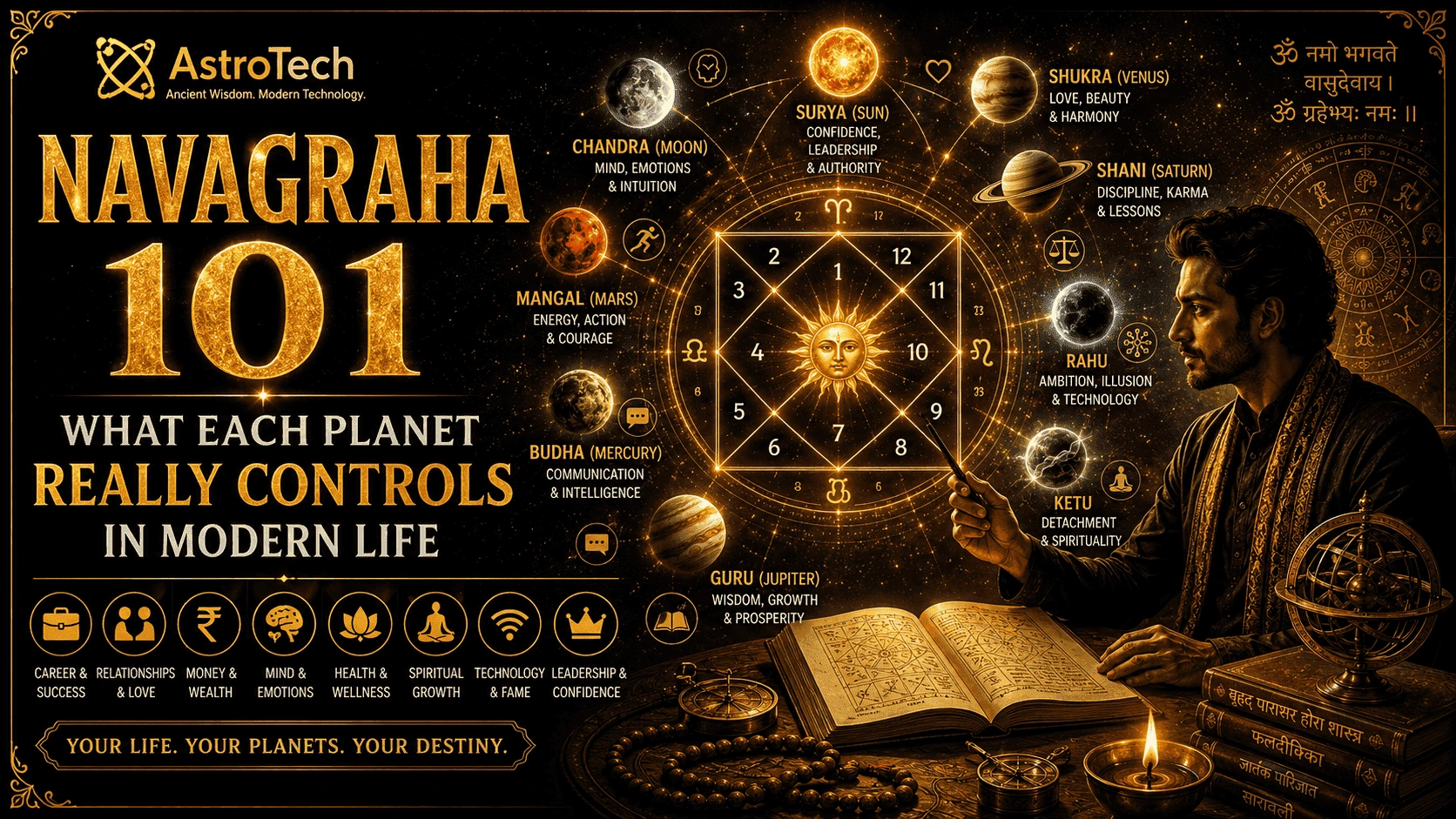
    In Vedic astrology, the nine planets — called Navagraha — map directly onto the domains that shape your personality, career, relationships, finances, and mental health. This guide explains what each planet actually controls in modern life, with real examples you’ll immediately recognise.

    What Are the Navagraha?

    Navagraha (Sanskrit: nava = nine, graha = planet/force) refers to the nine planetary energies in Vedic astrology that are believed to influence human behaviour, life patterns, and destiny.

    Unlike modern astronomy, Vedic astrology treats these planets as symbolic energies that operate through your birth chart, shaping:

    • Personality and confidence
    • Career direction and delays
    • Emotional patterns and mental health
    • Relationship dynamics
    • Financial instincts
    • Spiritual growth

    The nine Navagraha are: Sun, Moon, Mars, Mercury, Jupiter, Venus, Saturn, Rahu, and Ketu.

    The 9 Navagraha at a Glance: Modern Domain Table

    PlanetSanskrit NameWhat It ControlsModern Life Example
    SunSuryaEgo, authority, leadership, vitalityGetting a promotion vs. constant self-doubt
    MoonChandraMind, emotions, mental health, intuitionAnxiety, insomnia, mood swings
    MarsMangalEnergy, courage, aggression, actionStartup hustle, gym discipline, road rage
    MercuryBudhaCommunication, logic, business, writingAcing a negotiation or freezing on a pitch
    JupiterGuruWisdom, wealth expansion, mentorshipAvoiding a scam vs. falling for FOMO
    VenusShukraLove, luxury, creativity, relationshipsDating apps, credit card splurges, art
    SaturnShaniKarma, discipline, delays, hard workFive-year grind or chronic career stagnation
    RahuObsession, technology, ambition, illusionTikTok addiction, viral fame, shortcuts
    KetuDetachment, spirituality, inner wisdomQuitting social media, feeling lost after success


    What Each Planet Really Controls in Modern Life

    1. Sun (Surya) — Identity and Leadership

    The Sun governs your sense of self. It is the planet of confidence, authority, and public image — your ego in the most constructive sense.

    In modern life, the Sun controls:

    • Your leadership presence at work
    • Your relationship with father figures and authority
    • How you handle visibility, recognition, and reputation
    • Your ability to make decisions without seeking validation

    Strong Sun looks like: A natural leader who walks into a room and commands attention. CEOs, politicians, public figures, and people who are comfortable being seen.

    Weak Sun looks like: Constant self-doubt, fear of judgment, identity confusion, difficulty asserting yourself in meetings.

    Modern example: Two equally skilled candidates interview for a senior role. One speaks with quiet authority and owns their achievements. The other deflects credit and apologises mid-sentence. That difference is often Sun energy.

    Simple remedy: Spend two minutes watching the sunrise in silence. Step away from social media comparisons before 9 AM.

    2. Moon (Chandra) — Mind and Emotional Stability

    The Moon governs your inner emotional world. It is the planet of feelings, mental peace, and intuition — the force behind how you process experience.

    In modern life, the Moon controls:

    • Your baseline anxiety levels
    • Sleep quality and mental clarity
    • How you respond to stress and conflict
    • Your relationship with your mother and home environment
    • Emotional intelligence

    Strong Moon looks like: A calm, emotionally grounded person who processes feelings without spiralling. They sleep well, adapt easily, and are deeply intuitive.

    Weak Moon looks like: Overthinking, mood swings, emotional reactivity, insomnia, sensitivity to criticism.

    Modern example: The Moon is behind why two people receive the same piece of criticism — one shrugs and adjusts, the other replays it for days.

    Simple remedy: No screens one hour before bed. Drink water from a silver vessel. Meditate for five minutes before sleeping.

    3. Mars (Mangal) — Energy and Action

    Mars is the planet of drive. It rules physical energy, courage, ambition, and yes — anger.

    In modern life, Mars controls:

    • Your motivation to take action and compete
    • Physical fitness and stamina
    • How you handle conflict and aggression
    • Entrepreneurial boldness
    • Technical and mechanical skills

    Strong Mars looks like: Athletes, founders, military professionals, and anyone who converts competitive energy into results. Disciplined, decisive, physically active.

    Weak Mars looks like: Chronic laziness, passive-aggressive behaviour, inability to assert yourself, low physical energy.

    Modern example: The startup founder who pivots fast, works 14-hour days without burning out, and takes calculated risks — that’s strong Mars in action.

    Simple remedy: Channel aggression productively. Lift weights before responding to a stressful email. Avoid impulsive reactions in group chats.

    4. Mercury (Budha) — Communication and Intelligence

    Mercury governs the mind in action — how you think, speak, write, and connect ideas.

    In modern life, Mercury controls:

    • Writing, speaking, and persuasion ability
    • Business acumen and negotiation
    • Analytical thinking and problem-solving
    • Marketing, content, coding, and contracts
    • How clearly you communicate across all channels — emails, DMs, presentations

    Strong Mercury looks like: The person who writes copy that converts, explains complex ideas simply, and never sends a confusing message. Sales professionals, SEO experts, analysts, teachers.

    Weak Mercury looks like: Decision paralysis, miscommunication, inability to articulate thoughts, confusion in negotiations.

    Modern example: Two marketers pitch the same idea. One writes a crisp, compelling brief that gets approved in minutes. The other sends a long, meandering email that nobody responds to. Mercury is the difference.

    Simple remedy: Read for 20 minutes daily. Practise writing one clear paragraph before starting your workday.

    5. Jupiter (Guru) — Wisdom and Expansion

    Jupiter is the planet of growth, fortune, and good judgement. It is the most consistently beneficial force in Vedic astrology.

    In modern life, Jupiter controls:

    • Financial wisdom and wealth expansion
    • Higher education and mentorship
    • Marriage timing and spiritual ethics
    • Optimism and the ability to see the bigger picture
    • The quality of guidance you give and receive

    Strong Jupiter looks like: Teachers, advisors, coaches, and ethical business leaders. People who attract the right mentors, make sound financial decisions, and grow steadily over time.

    Weak Jupiter looks like: Poor financial judgement, lack of guidance, constant FOMO, falling for get-rich-quick schemes, cynicism about growth.

    Modern example: Strong Jupiter is getting a surprise refund when you needed it most, landing a client through a referral, or recognising a bad investment before you make it.

    Simple remedy: Give back — donate to education or feed someone genuinely in need. Practise gratitude before checking your bank balance.

    6. Venus (Shukra) — Love, Beauty, and Comfort

    Venus governs pleasure, aesthetics, and connection — your relationship with beauty, people, and comfort.

    In modern life, Venus controls:

    • Romantic relationships and attraction
    • Taste in fashion, design, art, and music
    • How you relate to luxury and lifestyle
    • Creative expression
    • Self-worth and how you let yourself receive love

    Strong Venus looks like: People with effortless aesthetic sensibility, healthy romantic relationships, creative talent, and a genuine enjoyment of life’s pleasures without guilt.

    Weak Venus looks like: Relationship instability, low self-worth, inability to set boundaries in love, unhealthy spending on status symbols, creative blocks.

    Modern example: Buying a luxury item because it genuinely brings joy is Venus in balance. Buying it to fill an emotional void or impress others is Venus under stress.

    Simple remedy: Spend time with art, music, or nature without your phone. Wear white on Fridays. Express appreciation to someone you love.

    7. Saturn (Shani) — Discipline and Karma

    Saturn is the planet of long-term truth. It is slow, serious, and relentless — and it rewards only what is real.

    In modern life, Saturn controls:

    • Career structure, delays, and long-term success
    • Discipline, consistency, and work ethic
    • Karma — cause and effect over years
    • Chronic health issues linked to neglect
    • Accountability and responsibility

    Strong Saturn looks like: The person who shows up every single day, does unglamorous work without complaint, and achieves goals others consider impossible because they simply never stopped. Patience, consistency, legacy.

    Weak Saturn looks like: Chronic procrastination, fear of commitment, career stagnation, financial debt, frustration at delayed results.

    Modern example: Saturn is your 401k contributions, your 5 AM alarm, and your decision to say no to social plans because you have a deadline. It is not exciting. It is everything.

    Simple remedy: Pick one discipline — sleep, exercise, savings — and maintain it for 90 days without exception.

    Rahu and Ketu: The Shadow Planets Explained Simply

    Rahu and Ketu are not physical planets — they are the lunar nodes, points where the Moon’s orbit crosses the Sun’s path. They are treated as shadow planets in Vedic astrology and represent the most psychologically complex energies of the nine.

    8. Rahu — Obsession and Material Ambition

    Rahu is the force of insatiable wanting. It amplifies desire, blurs the line between ambition and compulsion, and rules everything that feels urgent, addictive, and slightly out of reach.

    In modern life, Rahu controls:

    • Social media addiction and the hunger for likes
    • Viral fame and unconventional career paths
    • Technology, AI anxiety, cryptocurrency
    • Foreign travel, cross-cultural influence
    • The gap between appearance and reality

    Strong Rahu looks like: Disruptive innovators, people who succeed through unconventional routes, cultural bridge-builders, and anyone who achieves sudden, surprising success.

    Rahu out of balance looks like: Doomscrolling for two hours without remembering it. The urge to refresh your follower count every 20 minutes. Chasing shortcuts and quick wins at the expense of depth.

    Modern example: Rahu is the infinite scroll. Ketu (next) is the post-scroll emptiness where you cannot remember what you just watched.

    Simple remedy: Set a digital sunset — no phone one hour before bed. Eat at least one meal daily without any screen.

    9. Ketu — Detachment and Spiritual Depth

    Where Rahu wants everything, Ketu wants nothing. It is the energy of release, solitude, past-life wisdom, and turning inward.

    In modern life, Ketu controls:

    • Spiritual seeking and meditation
    • Minimalism and intentional simplicity
    • The feeling of being “done” with something that once mattered deeply
    • Anonymous work, deep thinking, and inner mastery
    • Losses that ultimately clarify what is real

    Strong Ketu looks like: Spiritual practitioners, deep thinkers, minimalists, researchers who care nothing for credit, and people who have survived loss and emerged wiser.

    Ketu out of balance looks like: Aimlessness, emotional disconnection, a vague sense of not belonging anywhere, self-sabotage right before success.

    Modern example: Deleting all your social media accounts on impulse. Feeling lost after hitting a goal you worked years for. That disorienting “now what?” — that is Ketu.

    Simple remedy: Practise sitting with silence. Journal without a specific goal. Meditate, even badly, consistently.

    Which Planet Controls What in Your Life?

    Life AreaPlanet to Look At
    Career and authoritySun
    Emotional health and mental peaceMoon
    Energy, drive, and physical healthMars
    Communication, business, contractsMercury
    Wealth, education, and wisdomJupiter
    Relationships and creativityVenus
    Karma, hard work, long-term outcomesSaturn
    Fame, technology, and obsessionRahu
    Spirituality and detachmentKetu


    Quick Checklist: Which Planet Is Affecting You Right Now?

    • Woke up exhausted despite enough sleep → Moon
    • Angry for no clear reason → Mars
    • Career has been stagnant for over a year → Saturn
    • Can’t stop checking your phone → Rahu
    • Feeling emotionally numb or disconnected → Ketu
    • Struggling to express yourself or communicate clearly → Mercury
    • Relationship feels unstable or unfulfilling → Venus
    • Lacking confidence or direction at work → Sun
    • Financial decisions feel scattered or unlucky → Jupiter

    Planet Remedies at a Glance

    PlanetSimple Modern Remedy
    SunTwo minutes of sunrise, reduce social comparison
    MoonNo screens before bed, water from a silver vessel
    MarsHeavy exercise before stressful decisions
    MercuryDaily reading, write one clear paragraph before work
    JupiterGive back genuinely, practise gratitude
    VenusTime with art or nature, express appreciation
    SaturnPick one discipline and hold it for 90 days
    RahuDigital sunset, one screen-free meal daily
    KetuSit in silence, journal without a goal

    Frequently Asked Questions

    What are the 9 planets in Vedic astrology?
    The nine planets in Vedic astrology, called Navagraha, are Sun (Surya), Moon (Chandra), Mars (Mangal), Mercury (Budha), Jupiter (Guru), Venus (Shukra), Saturn (Shani), Rahu, and Ketu. Each planet is associated with specific domains of life, personality traits, and karmic themes.

    What does Saturn control in astrology?
    Saturn controls discipline, karma, delays, hard work, and long-term success. In modern life it governs career structure, chronic health patterns linked to neglect, financial responsibility, and the consequences of sustained effort or avoidance over time.

    Which planet is responsible for mental health?
    The Moon primarily governs the mind, emotions, and mental stability. A well-placed Moon in your birth chart is associated with emotional intelligence, calm, and clarity. A challenged Moon can manifest as anxiety, overthinking, insomnia, and emotional instability.

    What do Rahu and Ketu mean in modern life?
    Rahu represents obsession, material ambition, and the hunger for more — visible today as social media addiction, viral fame, and technology overuse. Ketu represents detachment, spiritual depth, and the pull toward simplicity — visible as burnout, minimalism, and sudden disinterest in things you once craved.

    Which planet controls career success?
    Career is influenced primarily by the Sun (authority and recognition), Saturn (work ethic and long-term results), and Mercury (communication and business acumen). Jupiter also plays a significant role in wealth and opportunity expansion.

    Which is the most powerful planet in Vedic astrology?
    No single planet is universally most powerful — strength depends on placement, sign, and chart context. However, Jupiter, Saturn, and the Sun are often considered the most consequential for life direction and outcomes.

    Summary

    The Navagraha are not abstract mythology. They are a structured framework for understanding the forces that shape confidence, emotion, ambition, discipline, connection, and meaning in your daily life.

    Sun gives you identity. Moon gives you emotional ground. Mars gives you fuel. Mercury gives you voice. Jupiter gives you wisdom. Venus gives you beauty and love. Saturn gives you truth over time. Rahu gives you hunger. Ketu gives you peace — eventually.

    Understanding which planetary energy is active in your life right now is the first step toward working with it rather than against it.


    Want to know which planet is most active in your birth chart right now? Download the free Navagraha Quick Reference Card — nine planets, nine modern domains, one clear reference page.

  • Janam Kundali by Date of Birth — Free Online Kundli Guide for 2026

    Janam Kundali by Date of Birth — Free Online Kundli Guide for 2026

    Quick Answer: A Janam Kundali is a personalised Vedic birth chart built from your exact date, time, and place of birth. It maps every planet’s position across 12 houses at the moment you were born. You can generate one free in seconds on MyAstroTech — and get your Lagna chart, Dasha periods, doshas, and kundali matching all in one report.

    What Is a Janam Kundali?

    A Janam Kundali — also called a birth chart or Janam Patri — is the foundation of Vedic astrology. Think of it as a cosmic fingerprint: no two are exactly alike.

    It is a precise map of the sky at the exact moment of your birth. Every planet, every zodiac sign, every house placement is fixed to your unique birth data. Vedic astrologers use this map to interpret your personality, life patterns, and the timing of key events — from career shifts to marriage to financial cycles.

    Three inputs create your Kundali:

    • Date of birth — determines which signs the Sun, Moon, and planets were transiting.
    • Time of birth — sets your Lagna (Ascendant), the most personal part of the chart. Your Lagna changes roughly every two hours, so even a small error here reshapes the entire reading.
    • Place of birth — adjusts for latitude, longitude, and time zone.

    Vedic vs Western astrology: Vedic Kundali uses the sidereal zodiac — based on actual star positions — while Western astrology uses the tropical zodiac tied to seasons. The two differ by about 23 degrees (Ayanamsha). Most accurate Indian Kundli tools use the Lahiri Ayanamsa calculation, which is why your Vedic sign often differs from your Western sun sign.

    How to Generate Your Free Janam Kundali Online in 2026

    Generating a free kundali used to mean visiting a pandit with a register full of calculations. In 2026, the same Vedic mathematics runs in seconds online.

    To create yours on MyAstroTech:

    1. Go to the Free Kundli Generator.
    2. Enter your full name, gender, date of birth, exact birth time, and birth place.
    3. Click Generate — your full report loads instantly.

    What your free report includes:

    • Ascendant (Lagna) and Moon Sign (Rashi)
    • Positions of all nine planets across 12 houses
    • Current Mahadasha and Antardasha periods
    • Dosha check: Mangal Dosha, Kaal Sarp Dosha, Sade Sati status
    • Basic personality and life path summary
    • Navamsa (D9) chart

    The single most common mistake people make: entering an approximate birth time. Even a five-minute error can shift your Lagna sign and change the entire house structure. Check your birth certificate before you generate.

    The 12 Houses of Your Kundali — What Each One Governs

    Your birth chart divides into 12 houses, each representing a specific area of life. Here is what each house covers:

    Houses 1–4: Identity, Wealth, Communication, Home

    HouseSanskrit NameLife Area
    1stLagna / Tanu BhavaBody, personality, appearance, overall life direction
    2ndDhana BhavaFamily wealth, speech, early education
    3rdSahaj BhavaSiblings, courage, communication, short travel
    4thSukh BhavaMother, home, vehicles, inner peace, property

    The 1st house is the anchor of your entire chart. A strong Lagna lord means resilience across most challenges.

    Houses 5–8: Creativity, Rivals, Marriage, Transformation

    HouseSanskrit NameLife Area
    5thPutra BhavaChildren, creativity, romance, intelligence
    6thRipu BhavaEnemies, debts, disease, daily work
    7thKalatra BhavaMarriage, business partners, public dealings
    8thAyur BhavaLongevity, inheritance, sudden events, transformation

    The 7th house is the one most people ask about first. Its lord and any planets placed here shape your entire married life.

    Houses 9–12: Fortune, Career, Gains, Liberation

    HouseSanskrit NameLife Area
    9thBhagya BhavaLuck, father, higher learning, dharma, long travel
    10thKarma BhavaCareer, reputation, authority, achievements
    11thLabha BhavaIncome, social circles, elder siblings, wish fulfilment
    12thMoksha BhavaExpenses, foreign lands, spiritual liberation, losses

    The 10th house is your career house. Saturn here often brings a slow, disciplined rise. Jupiter points to law, teaching, or advisory roles. Mercury indicates communication-driven careers.

    Doshas and Yogas — What to Look For in Your Chart

    A Kundali shows both friction and blessing. Doshas are areas that need attention. Yogas are combinations that generate strength.

    Common doshas to check:

    Mangal Dosha (Manglik): Formed when Mars sits in the 1st, 2nd, 4th, 7th, 8th, or 12th house. It primarily affects married life and is one of the first things checked before a wedding alliance. Many placements carry natural cancellations, and practical remedies exist for those that do not.

    Kaal Sarp Dosha: Occurs when all planets fall between Rahu and Ketu in the chart. It can cause delays and cycles of ups and downs. It carries twelve sub-types, including Ananta, Kulika, and Vasuki, each with a slightly different expression.

    Pitra Dosha: Linked to ancestral karma. Typically shows up when the Sun is conjunct Rahu or placed in certain afflicted positions.

    Powerful yogas to identify:

    Raj Yoga: Lords of Kendra houses (1, 4, 7, 10) and Trikona houses (1, 5, 9) connect. Indicates authority, power, and significant achievement.

    Dhana Yoga: Lords of wealth-giving houses (2nd, 5th, 9th, 11th) combine. Points to financial abundance during certain Dasha windows.

    Gajakesari Yoga: Jupiter sits in a Kendra position from the Moon. Brings wisdom, social respect, and long-term stability.

    One important note: a dosha in your chart is not a sentence. Most doshas have well-documented cancellation conditions and remedies. Context — planet strength, house lordship, and active Dasha — determines the actual impact.

    Kundali Matching for Marriage — How Ashta Koot Milan Works

    Kundali matching, also called Guna Milan or Ashtakoot Milan, is the Vedic framework for assessing marriage compatibility. It evaluates two birth charts across eight parameters called Kootas, with a total possible score of 36 points.

    The 8 Kootas:

    KootaMax PointsWhat It Measures
    Varna1Spiritual compatibility and ego alignment
    Vashya2Mutual attraction and influence
    Tara3Health and destiny alignment
    Yoni4Physical and intimate compatibility
    Graha Maitri5Mental and intellectual rapport
    Gana6Temperament match
    Bhakoot7Family harmony and financial prosperity
    Nadi8Health, genetics, and progeny

    A score above 18 is generally considered acceptable. The higher the score, the stronger the indicated compatibility.

    However, the raw number is only part of the story. A score of 20 with a zero in Nadi (Nadi Dosha) raises more concern than a score of 20 with low Varna and Vashya but full Nadi points. The specific kootas that score low carry their own weight.

    Guna Milan is an important tool — not the only determinant. Marriage outcomes also depend on Navamsa compatibility, Dasha alignment, Mangal Dosha cross-matching, and genuine emotional compatibility between the two people.

    Planetary Dashas — How Your Birth Chart Shows Life Timing

    What makes Vedic astrology distinct from most other systems is the Dasha framework. Your chart does not just show static positions — it shows timing.

    The Vimshottari Dasha system divides your life into planetary periods. Each planet rules a specific number of years:

    PlanetYears
    Sun6
    Moon10
    Mars7
    Rahu18
    Jupiter16
    Saturn19
    Mercury17
    Ketu7
    Venus20

    Within each Mahadasha there are sub-periods (Antardasha) and sub-sub-periods (Pratyantardasha). Understanding your current Dasha sequence tells you which planetary themes are active right now — and for how long.

    A well-placed Jupiter Mahadasha typically brings expansion, wisdom, and growth. A Saturn Mahadasha often brings restructuring and hard work — demanding, but deeply rewarding when Saturn is strong in the chart. Timing major decisions around your Dasha periods is one of the most practical applications of your Kundali.

    Aaj Ka Rashifal — Daily Horoscope Based on Your Rashi

    Your Rashi is your Moon sign — the zodiac sign the Moon occupied at your birth. In Vedic astrology, the Moon sign carries more weight than the Sun sign for daily predictions, because the Moon governs emotional state, mental patterns, and day-to-day experience.

    The Moon moves through signs roughly every 2.25 days, making it the fastest-changing major indicator in your chart. Rashi-based daily horoscopes track this movement and give you a reading calibrated to your Moon’s natal placement.

    Newspaper and app horoscopes based on Sun sign alone cover roughly one-twelfth of the world’s population with a single prediction. Your Kundali is calculated specifically for your date, time, and place. The difference in precision is significant.


    Aaj Ka Panchang — Five Elements of the Vedic Day

    Panchang refers to the five attributes that define each day in the Vedic calendar: Tithi (lunar day), Vara (weekday), Nakshatra (constellation), Yoga (luni-solar combination), and Karana (half-lunar day). Together, these determine which activities are auspicious and when the most favourable windows — Muhurta — occur.

    Checking today’s Panchang in isolation is useful. Layering it over your personal birth chart is powerful. If today’s Moon is transiting your 10th house from your natal Moon sign, it is generally a favourable window for career-related action. If the current Nakshatra is unfavourable for your Janma Nakshatra, signing contracts or launching initiatives is worth delaying. This cross-reference is the step most people skip.

    Numerology and Your Kundali — Birth Number, Name Number, and Planetary Links

    Chaldean numerology is one of the oldest numerological systems, and it maps directly onto Vedic planetary energies. Each number corresponds to a planet:

    NumberPlanet
    1Sun
    2Moon
    3Jupiter
    4Rahu
    5Mercury
    6Venus
    7Ketu
    8Saturn
    9Mars

    Birth Number (Psychic Number): The day of the month you were born, reduced to a single digit. Born on the 25th — 2+5 = 7 (Ketu). This number is fixed and unchangeable, making it a constant reference point throughout life.

    Destiny Number: The sum of all digits in your full birth date, reduced to a single digit.

    Name Number: Each letter in your name carries a Chaldean value. The overall name number reflects the vibrational quality of your identity as others encounter it.

    When your name number aligns with your birth number, it creates harmony. A mismatch can explain persistent friction in specific areas of life — and adjusting the spelling of a name is one of the more common numerological remedies.

    Common Mistakes When Reading Your Kundali Online

    These errors lead people to wrong conclusions far more often than the chart itself:

    Wrong birth time. A five to ten minute error can shift your Lagna to a different sign entirely. Use your birth certificate, not a family estimate.

    Confusing Lagna with Rashi. Your Ascendant and Moon sign serve different functions. Predictions meant for one should not be read as the other.

    Relying only on the Sun sign. This is a Western habit. In Vedic astrology, the full chart — all 12 houses, all nine planets, active Dashas — tells the real story.

    Ignoring Dasha periods. A strong planet in your chart does not deliver results outside its Dasha window. Placement shows potential; timing determines activation.

    Panicking over doshas. Most doshas have cancellation conditions or practical remedies. Seeing Mangal Dosha or Kaal Sarp in your report is a signal to read further, not a cause for alarm.

    Using tropical instead of sidereal calculations. Verify that your tool uses Vedic Lahiri Ayanamsa. Tropical calculations produce a different chart that does not align with the Vedic system.

    Skipping the Navamsa (D9) chart. The Rashi chart shows the tree; the Navamsa shows the fruit. Planet strength — especially for marriage and fortune — cannot be fully assessed without it.

    10 Questions People Ask About Janam Kundali

    What is the difference between a horoscope and a Kundli? A horoscope is a generalised prediction based on your Sun or Moon sign. A Kundli is your full birth chart — 12 houses, nine planets, Dasha periods, divisional charts — calculated specifically for your birth data. A horoscope is a weather update; a Kundli is the full climate report.

    Can I get a Kundali without my birth time? Some tools default to sunrise time when birth time is unknown. The result will be approximate — your Lagna and house placements will be unreliable. For career, marriage, or Dasha-based questions, accurate birth time is essential.

    What birth details are needed for a Kundali? Three things: exact date of birth, exact time of birth, and place of birth. Precision on all three gives you a reliable chart.

    How is Rashi (Moon sign) different from Sun sign? Your Rashi is the zodiac sign the Moon occupied at your birth. Your Sun sign is the sign the Sun occupied. In Vedic astrology, the Moon sign carries more weight for daily prediction and emotional patterning.

    What is a planetary Dasha? A Dasha is a planetary period in the Vimshottari system. Each planet rules a set number of years, within which sub-periods run. Your current Dasha indicates which planetary themes are most active in your life right now.

    Can astrology predict marriage timing? With reasonable precision, yes. The Dasha periods of the 7th house lord, Venus, and Jupiter are the primary indicators. Jupiter transiting the 7th house or its lord often activates marriage events.

    What is Guna Milan and how many points indicate a good match? Guna Milan compares two charts across eight parameters (Kootas) for a total of 36 points. A score above 18 is considered acceptable; higher is generally better. The specific Kootas that score low matter as much as the total.

    What is Kaal Sarp Dosha? It forms when all seven visible planets fall between Rahu and Ketu in the chart. It tends to produce cycles of delay and disruption, though the severity depends on which of its twelve sub-types is present and how other chart factors balance it.

    How often should I consult an astrologer? For daily use, check Rashifal and Panchang. For major decisions — career change, marriage, business launch, property — a detailed consultation once or twice a year is practical. During challenging Dasha periods such as Sade Sati or Rahu Mahadasha, quarterly check-ins help maintain perspective.

    Is Vedic astrology accurate? Vedic astrology is a rule-based system grounded in astronomical mathematics and thousands of years of documented observation. Its accuracy depends on correct birth data and the depth of interpretation. A free tool gives you the raw chart; a skilled astrologer gives you the nuanced reading.

    What Your Kundali Can Guide — Practical Applications

    A birth chart is most useful when applied to real decisions:

    Career: The 10th house, its ruling planet, and the active Dasha indicate the right direction — and explain why effort in certain periods yields more than the same effort in others.

    Marriage: The 7th house and Venus placement reveal patterns. Dasha timing narrows the window when marriage is most likely to manifest.

    Finance: The 2nd and 11th houses, combined with Jupiter’s strength and placement, indicate income growth periods and areas requiring caution.

    Business timing: The 10th house, Mercury, and active Dasha help identify when to launch versus when to consolidate.

    Newborn naming: Janma Nakshatra determines the syllable range used for a baby’s name — a tradition grounded in sound vibration and planetary resonance.

    Daily decisions: Panchang layered over your natal chart gives you time-specific guidance that generic horoscopes cannot.

    Key Facts to Remember

    • A Janam Kundali requires your exact date, time, and place of birth — all three matter.
    • The Lagna (Ascendant) changes every two hours; birth time accuracy is non-negotiable.
    • Vedic astrology uses the sidereal zodiac with Lahiri Ayanamsa — not the tropical zodiac.
    • Doshas like Mangal and Kaal Sarp are indicators of challenge, not fixed outcomes. Most have documented remedies.
    • Kundali matching scores above 18 out of 36 are considered acceptable; the specific Kootas that score low carry their own weight beyond the total.
    • Your Dasha period determines when planetary potential in your chart actually activates.
    • The Navamsa (D9) chart is essential for assessing true planetary strength, especially for marriage and fortune.
    • Chaldean numerology maps directly onto Vedic planetary energies — the two systems complement each other.

    Your Kundali is not a verdict. It is a map of the terrain — the climbs, the open roads, the likely weather. What you build with that information is still entirely yours.